
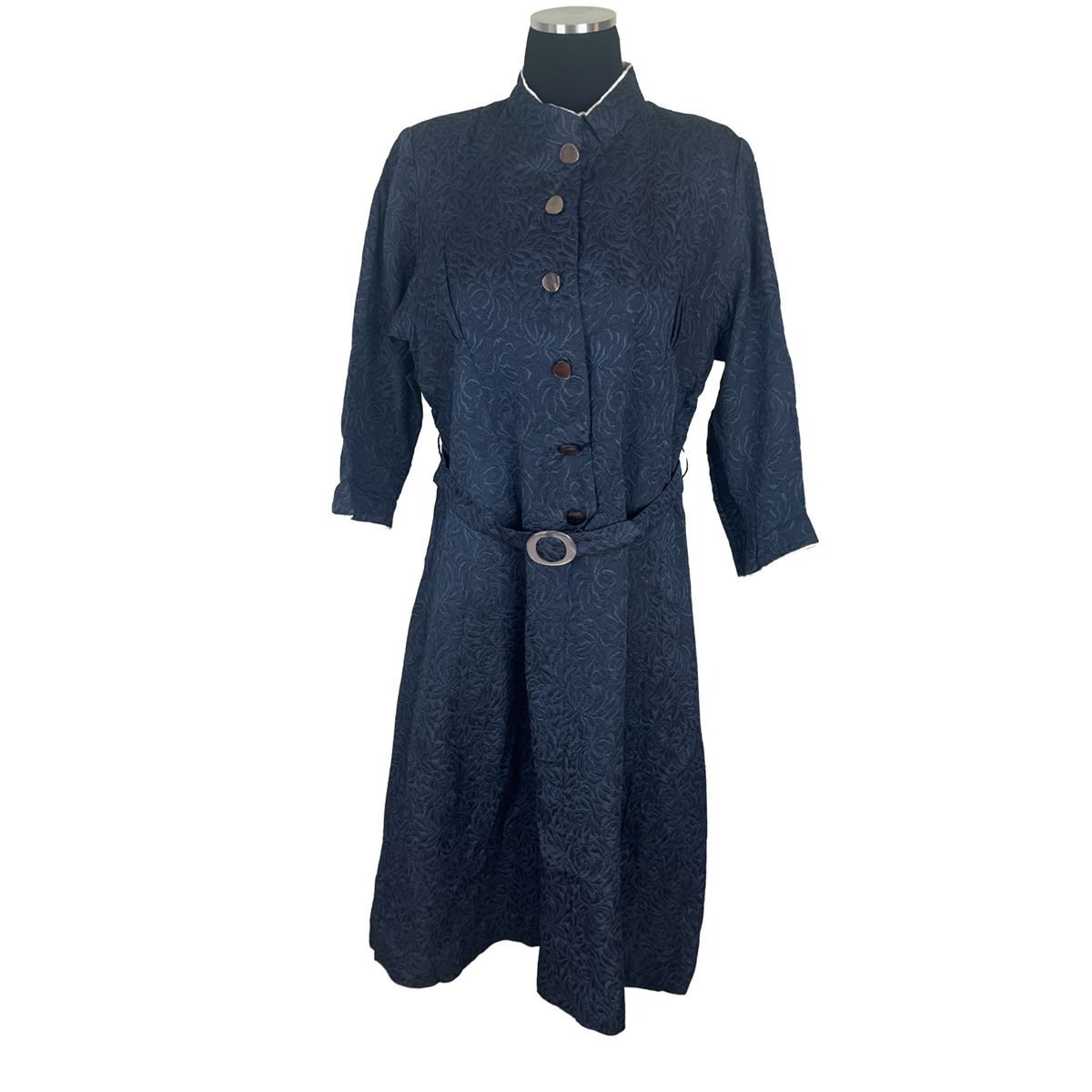
I have to admit, when I first laid eyes on this dress, my vintage-loving heart skipped a whole beat. There is something profoundly magical about finding a handmade garment from the 1940s that has survived the decades with such incredible grace. This isn’t just a dress; it is a wearable archive, a testament to the ingenuity and skill of mid-century home sewing, and quite possibly one of the most uniquely constructed pieces I have ever had the pleasure of bringing to the shop.
Let us start with the fabric, because it is an absolute tactile delight. The garment is constructed from a substantial, heavy-weight jacquard or brocade in the most intoxicating shade of midnight navy blue. When the light hits it just right, the dimensional weave reveals a gorgeous, swirling floral motif that looks almost like abstract roses trailing across a midnight garden. The weight of the fabric gives the dress a magnificent, structured drape—it doesn’t cling; it commands space. It feels protective, elegant, and unapologetically bold, exactly as 1940s fashion was designed to be.
But the true genius of this dress lies in its clever deceptions. Running down the front bodice is a row of stunning, iridescent buttons. They possess the luminescent gleam of mother-of-pearl or natural shell, shifting from bright, pearly white to deep, stormy greys depending on the angle. However, these buttons are purely decorative! Instead of dealing with fussy buttonholes, the dress features a deeply practical, full-snap front closure hidden just beneath the placket. During the WWII era, when metal zippers were rationed and hard to come by, resourceful sewists often turned to heavy-duty snaps. Not only does this add a fascinating historical detail, but from a purely modern standpoint, it makes getting in and out of this structured masterpiece an absolute breeze.
The silhouette is classic 1940s perfection. It starts with a high, modest collar that frames the face beautifully, edged in a delicate, contrasting metallic piping that catches the light with a subtle silver-gold shimmer. This same metallic accent is echoed at the cuffs of the lovely three-quarter-length sleeves. And oh, the shoulders! This dress boasts formidable, sewn-in shoulder pads that create that iconic, structured wartime silhouette.
Speaking of those shoulder pads—they hold my absolute favorite secret of the entire garment. When you look inside the dress at the padding, you will find a scrap of fabric bearing a distinct, printed German label: “BEMBERG BATIST waschbar, kochecht, bügelfest.” For the fabric nerds out there (and I know you are my people), Bemberg is a famous type of cupro rayon invented in Germany. The text proudly advertises that the batiste fabric is washable, colorfast, and iron-proof. The fact that the maker of this dress repurposed a stamped scrap of German utility fabric to build the shoulder pads is a breathtaking piece of history. It tells a story of make-do-and-mend resourcefulness, offering a literal hidden message from the past.
The dress is pulled together by its original, matching fabric belt, which is an incredible rarity. So often, original belts are lost to the sands of time, but this one remains completely intact, featuring a fantastic, chunky O-ring buckle made of what feels like vintage lucite or early plastic. The belt loops securely through and snaps into place, allowing you to cinch the waist to your exact preference. The skirt falls in a graceful, A-line sweep to a classic midi length, completing a look that is both highly structured and deeply feminine.
Condition-wise, this beauty is a marvel. Because it is handmade, you will see the tell-tale signs of human hands in the stitching—a slightly uneven hem here, a hand-whipstitched seam there—but these are not flaws; they are the fingerprints of the woman who painstakingly crafted this garment over eighty years ago. There are no structural holes, no devastating stains, just decades of carefully preserved history ready for its next chapter.
Styling this piece today is an absolute joy. For a fiercely authentic vintage look, pair it with seamed stockings, a classic leather pump, and a bold red lip. Want to bring it into the 21st century? Throw it on over a pair of modern platform boots, ditch the belt for a looser, oversized fit, and wear it almost like a lightweight, snap-front duster coat. The heavy brocade fabric lends itself perfectly to transitional weather, acting as a stunning outer layer for a crisp autumn afternoon.
Pieces like this do not come around often. This 1940s navy brocade dream is waiting for a caretaker who will appreciate its hidden snaps, its secret German shoulder pads, and its undeniable, timeless swagger.
Measurements:
Bust (Pit to Pit): 40″
Waist (Belted): 34″
Waist (Unbelted/Maximum): 38″
Hips: 42″
Length: 42″
Modern Size Estimate: Large (US 12/14)
A Piece of a Forgotten Estate: The “Sister” Dress
Vintage lovers, we have uncovered a true historical mystery! This dress is one of two spectacular navy blue garments we acquired, and I am convinced they belonged to the exact same woman.
How do I know? Both this dress and its “sister” piece share a rare mid-century size profile (a 40-inch bust and 34 to 36-inch waist). Furthermore, both dresses utilize the exact same obscure German sewing notions hidden inside! One features dress shields stamped “waschbar kochecht” (German for washable/boil-proof), while the other features homemade shoulder pads crafted from German utility batiste bearing the exact same phrasing.
Given their era (late 1930s/early 1940s) and origins from a dusty St. Louis warehouse, I believe these belonged to a fashionable German immigrant or a fiercely loyal seamstress using imported notions just before the war.
It is incredibly rare to keep an estate together after 80 years. If you are a collector, you simply must see this dress’s sister piece! Check out this 1930s-40s Dress with Gelatin Sequins to view the other half of this incredible Midwestern WWII-era wardrobe.
Historical Context & Collector Notes for this 1940s Handmade Navy Blue Floral Brocade Midi Dress
This 1940s handmade navy blue floral brocade midi dress is a striking example of how women’s fashion during the World War II era balanced practicality, elegance, and personal expression. Clothing from the 1940s was shaped by a world in transition. Wartime restrictions, fabric rationing, and the need for utility influenced everything from silhouette to construction, yet many garments from the decade still carried an unmistakable grace. Dresses like this one reveal how style endured even in years defined by austerity. Its tailored structure, thoughtful detailing, and decorative floral brocade surface speak to a period when women often sought beauty in garments that were also expected to be durable, adaptable, and wearable across multiple settings.
The silhouette of a 1940s midi dress is especially significant in understanding the era. In the early and mid-1940s, fashion moved away from the sweeping excess of the 1930s and toward more controlled, functional lines. Hemlines often sat below the knee, creating a practical yet flattering proportion that suited both daywear and semi-formal use. This midi length reflects the decade’s emphasis on modesty, mobility, and efficient use of fabric while still preserving femininity. Many dresses from this era were designed to create shape through cut and seaming rather than through excess trimming, and that restraint is part of what makes authentic 1940s garments so enduringly sophisticated to modern collectors.
The handmade nature of this dress adds another important layer of historical value. During the 1940s, home sewing and custom dressmaking became especially important. Women frequently altered existing garments, repurposed textiles, or commissioned handmade pieces that mirrored current silhouettes while reflecting personal taste. A handmade 1940s dress can often offer a level of individuality and craftsmanship not found in mass-produced clothing. It also tells a more intimate story: someone selected the fabric, chose the buttons, planned the fit, and assembled the garment with care. For collectors, handmade wartime and postwar dresses are deeply appealing because they preserve not only the aesthetic of the era, but also the resourcefulness and artistry that defined everyday dressmaking during the period.
The navy blue floral brocade fabric is one of the most collectible features of this piece. Navy was a favored and versatile color in the 1940s, appreciated for its elegance, practicality, and easy transition from daytime to evening-adjacent wear. It offered much of the formality of black while remaining softer and more adaptable. The floral brocade texture elevates the garment beyond a purely utilitarian dress, adding depth, sheen, and visual richness. Brocade fabrics have long been associated with refinement, and in a 1940s context, a floral brocade dress suggests an effort to maintain beauty and polish in a decade when clothing often had to serve many purposes. For vintage fashion collectors, original brocade garments from the 1940s are especially desirable because the fabric itself communicates both luxury and historical character.
Another standout detail is the use of mother-of-pearl buttons, which lend delicacy and luminosity to the design. Buttons in 1940s garments were rarely an afterthought. Because trims and embellishments were more limited than in earlier decades, closures often became part of the visual identity of a garment. Mother-of-pearl buttons bring a subtle elegance that contrasts beautifully with navy floral fabric, and their presence signals attention to finish and design harmony. Collectors often value original period buttons highly, especially when they remain intact, because they help preserve the authenticity of the piece and can reveal the maker’s original intent.
The snap-front construction also reflects the practical sensibility of the era. Front closures made dresses easier to wear and more useful in daily life, a key consideration in the 1940s when clothing needed to function hard and well. Utility was not separate from style during this decade; it was woven into it. Features like snap-front openings, manageable lengths, and sturdy but attractive materials allowed dresses to move with women through busy routines while still presenting a polished appearance. This fusion of convenience and elegance is one of the reasons authentic 1940s dresses continue to resonate with modern collectors, historians, and stylists alike.
The inclusion of the original belt is especially noteworthy from a collector’s perspective. So many vintage garments have lost their belts over time, making surviving examples with original accessories increasingly scarce. In 1940s fashion, belts were essential to defining the waistline and reinforcing the era’s structured silhouette. A dress retaining its original belt offers a more complete and historically faithful presentation of how the garment was intended to be worn. For collectors, originality matters, and pieces with matching or original components tend to be more desirable because they preserve the integrity of the design. The belt here is not merely an accessory; it is part of the garment’s architectural identity.
From a broader fashion history standpoint, this dress embodies the tension and beauty of 1940s womenswear: restraint paired with refinement, economy paired with elegance, and practicality paired with unmistakable charm. It represents a decade in which clothing carried emotional as well as functional importance. Garments were expected to last, to flatter, and to adapt. Yet even within those constraints, makers and wearers found ways to incorporate texture, shine, floral motifs, and graceful finishing touches. That balance is exactly what gives 1940s vintage dresses their lasting appeal in the modern market.
For today’s vintage collectors, a 1940s handmade navy blue floral brocade dress with mother-of-pearl buttons, snap-front construction, midi length, and original belt stands out as a highly evocative example of mid-century craftsmanship. It appeals not only as a wearable antique, but also as a document of social and material history. It speaks to wartime-era style, home sewing traditions, textile choice, and the enduring elegance of well-made vintage fashion. Pieces like this are treasured because they bridge fashion history and personal narrative, preserving the details of an era when every garment had to do more—and mean more.
In collector terms, this is the kind of 1940s vintage dress that holds attention for multiple reasons: strong period silhouette, handmade provenance, textured floral brocade, original finishing details, and a completeness that includes the belt. Whether appreciated for its historical resonance, its decorative beauty, or its rarity as an intact handmade piece, it stands as a compelling example of why authentic 1940s dresses remain among the most admired categories in vintage clothing.