
A big day at the fair
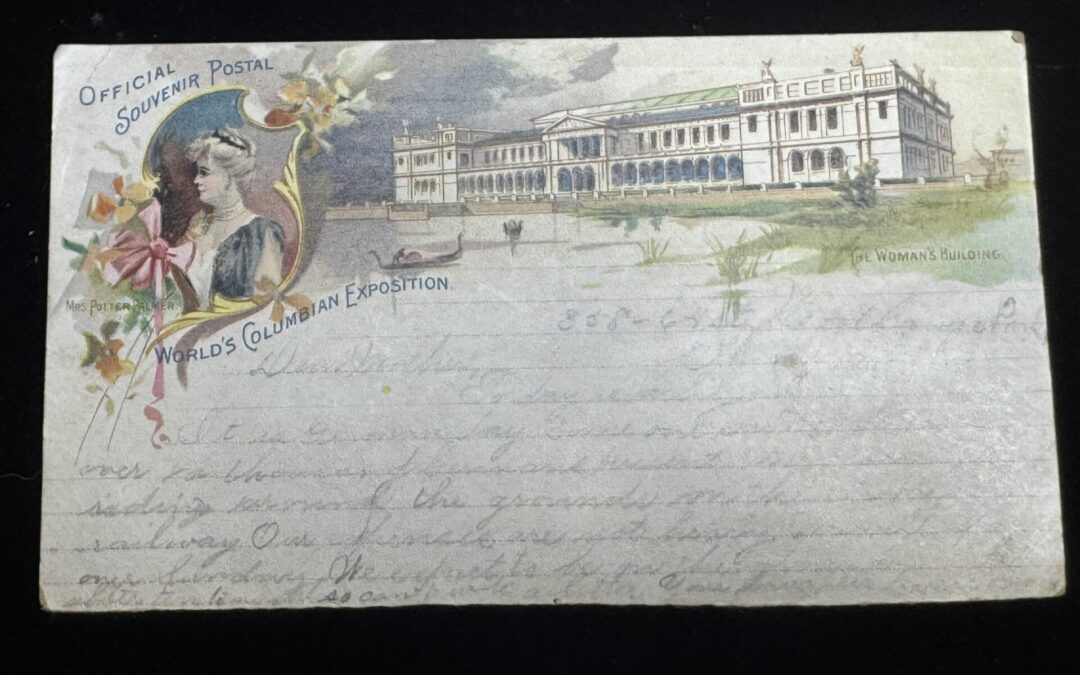
“A big day at the fair.” That’s how the message on this postcard begins, and a few lines later the writer adds, “It is German day.” It was written to “Dear Mother” in June of 1893, in the middle of the World’s Columbian Exposition in Chicago, and it has traveled 133 years to end up in my hands.
This is my favorite postcard out of everything my friend Maury has shown me from his stamp and postcard collection. Plenty of antique postcards are pretty. This one talks. It has a crowd, a ride on an elevated railway, a plan to stay through the weekend, and the unmistakable feeling of someone squeezing in a quick note before the next thing on the itinerary pulls them away.
It also happens to be a piece of postal history: one of the earliest official souvenir picture postcards ever sold in the United States.
What the card says
The front is a color lithograph of the Woman’s Building, with a gondola drifting across the lagoon in the foreground. In a gilded frame on the left is a portrait labeled “Mrs. Potter Palmer,” and the blue lettering reads “Official Souvenir Postal, World’s Columbian Exposition.”
The address side is printed “This side is for address only,” which is why the message runs straight across the picture. Here is my best reading of it, with […] wherever the handwriting is too faint or tangled for me to be sure:
Dear Mother,
To day is a big day at the fair. It is German day. Some one said there were over a thousand Germans present. At present […] riding around the grounds on the elevated railway. Our friends are not leaving. We will stay over Sunday. We expect to be on the ground […] so can’t write a letter. […]
In the upper right corner the writer jotted a Chicago address: 358 64th St., Woodlawn Park.
A few things I love about it. The crowd count is hearsay (“Some one said…”), which is exactly how anyone reports a big event while standing in the middle of it. The new elevated railway that circled the grounds gets a name-check. And “so can’t write a letter” tells me this card was the letter: a quick dispatch home from a visitor with plans to stay through the weekend.
The woman in the frame
The portrait on the card is Bertha Honoré Palmer, printed as “Mrs. Potter Palmer,” the Chicago socialite who presided over the fair’s Board of Lady Managers. According to the National Park Service, the Board’s 117 members were the first women to serve in an official capacity at a world’s fair, and the Woman’s Building pictured on the card was their showpiece: a hall of art, crafts and exhibits made by women.
The building was designed by Sophia Hayden, who was 21 and the first woman to earn a four-year architecture degree from MIT when she won the design competition. The pressure of the job (and the Board’s constant demands) reportedly broke her health, and it was her first and last completed building.
I love this card, and I also think it’s worth saying out loud that the story behind that building isn’t tidy. The Board declined to show Black women’s accomplishments on their own, and Ida B. Wells, Fannie Barrier Williams and Frederick Douglass objected loudly. The fair’s buildings were also temporary by design, and the Woman’s Building was burned or demolished within about a year. Much of what we know about that “White City” survives in souvenirs like this one.
German Day, June 15, 1893
The “big day” was Thursday, June 15, 1893, and the writer’s headcount turned out to be wildly low. Hubert Howe Bancroft’s Book of the Fair says German Day broke all previous attendance records, with more than 200,000 people admitted and at least 50,000 of them German.
The program was enormous: a parade of more than 16,000 people with floats and coaches, speeches in front of the German Building, an evening concert at Festival Hall, and fireworks that ended with Germania and Columbia standing side by side in lines of fire. Carter H. Harrison gave the closing address and admitted he was at a disadvantage, speaking against a brass band and a thunderstorm.
The elevated railway the writer mentions was the fair’s Intramural Railway, an electric train on a roughly three-mile loop around the grounds. According to this history, riders bought about 5.8 million tickets over the six months, and some visitors from small towns rode for hours looking for the end of the line without realizing it looped.
The Chicago address on the card is a clue too. The fair also turned the neighborhoods around Jackson Park into lodging country, and the Hyde Park Historical Society notes that many private homes rented out furnished rooms to fairgoers. I can’t tell whether the writer was in a boarding house or staying with friends, but 64th Street in Woodlawn Park fits the pattern.
The card itself
This is one of Charles W. Goldsmith’s “Official Souvenir Postals,” printed in color on the white coated back of the government’s one-cent Grant postal card. According to Postcard History, Goldsmith won the fair’s contract on April 21, 1893, the cards sold from vending machines on the grounds at two for five cents, and the earliest recorded use of any of them is May 22, 1893. Ours was mailed less than four weeks after that.
The cards were printed by the millions (fair records point to roughly 1.8 million sold on the grounds alone), so what sets this one apart is everything else: a readable message, a named event, a Chicago address, and a fair-station postmark.
Flip it over and you get the one-cent Grant portrait, the line reading “This side is for address only,” and a circular World’s Fair Station date stamp (the morning of June 16, 1893, the day after German Day) with heavy canceling bars struck across the card. It’s addressed to Mrs. Henry Bishop of Nora Springs, Iowa, which presumably makes the writer one of her children. If any of those names ring a bell for you, tell me, because I’d love to fill in this card’s family story.
Giving Maury’s collection a next chapter
I know Maury through a small group of acquaintances that meets every Thursday here in West Lafayette, Indiana. I love history, and he has collected some of it: this card comes from his stamp and postcard collection. I’m helping him find good homes for the pieces, and I take that seriously. The goal isn’t just to move things along; it’s to put each one in the hands of someone who will actually appreciate it, whether that’s a postal historian, a Chicago-history buff, a genealogist, or someone who simply loves a handwritten message from 1893.
Of everything he’s shown me so far, this is the one I keep coming back to. A lot of postcards show you what a place looked like. This one tells you what it felt like to be there: a crowd, a parade, and a letter you don’t have time to write. And yes, I noticed that German Day fell on a Thursday, just like our weekly get-together.
Where this postcard goes next
If you’d like to give it a home, it’s listed in my eBay shop: 1893 Worlds Fair Columbian Exposition Woman’s Building Postal Card. The listing describes it as in very good antique condition for its age, priced at $65 as of this writing, with offers welcome, and it ships from West Lafayette, Indiana.
Whoever wrote “a big day at the fair” probably never imagined a stranger reading it 133 years later. Someone clearly saved it, and now it’s looking for its next keeper.
Further reading
- Charles W. Goldsmith’s Official Columbian Exposition Postal Cards, Postcard History
- Women’s History at the 1893 World’s Columbian Exposition, National Park Service
- The Book of the Fair, Chapter 25: Foreign Exhibits, Illinois Institute of Technology digital collection
- An Endless Ride on the Intramural Railway at the 1893 World’s Fair
- Where did visitors stay?, Hyde Park Historical Society open house notes
Pictures of this 1893 World’s Fair Postcard:


