

Preface to Chapter III: August Frederick Bohnenkamp, Minnie Koch Bohnenkamp, and Their Children
Chapter III is where this project suddenly comes much closer to my own family.
In this chapter, Reverend Sam D. Bohnenkamp writes about his parents, August Frederick Bohnenkamp and Wilhelmina “Minnie” Koch Bohnenkamp, and their children. On the surface, it is another dense family-history chapter — names, dates, marriages, deaths, farms, schools, cemeteries, churches, obituaries, children born and children lost.
But tucked inside all of that is my grandmother.
Sam briefly mentions Mrs. Rosetta Caldwell Bochawitz Bohnenkamp — my grandma Rosetta Caldwell — and her marriage to Wilbur Bohnenkamp. He writes that Wilbur married Rosetta, a widow whose first husband had been killed in World War II, and that she had two sons from that first marriage: Carl Edward and William Paul. Sam spells the surname as “Bochawitz,” though I am sure this is one of those family names that gets misspelled constantly in records, indexes, newspapers, and memory. I have seen and heard variations, and even now I hesitate before typing it because genealogy loves nothing more than humbling you with one vowel.
Rosetta and Wilbur then had two children together: Peggy Susan and William Douglas. William Douglas Bohnenkamp is my father.
That means this chapter contains one of those little genealogical knots that is technically simple but emotionally strange: my dad, William Douglas, had an older half-brother named William Paul. I knew him as Paul, partly because my dad’s first name was also William. And even though this kind of repeated first-name pattern can make genealogical research feel like some sort of cruel logic puzzle, it was not unusual historically — even fairly recently — for families to reuse names, honor relatives, or distinguish people by middle names, nicknames, or whatever everyone in the family actually called them.
In records, though? Chaos. Absolute chaos.
Reading Sam’s words now, with everything I know came later, is hard in a way he could not have understood when he was writing in the early 1960s. At the time, Rosetta’s eldest son, Carl Edward, was still alive. Sam records him as a young man who had graduated from Sullivan High School, spent time in the Army, attended the University of Missouri, worked as a patrolman in St. Louis, and was studying sociology.
A few years later, Carl would be dead.
Carl Edward Bockewitz died on February 28, 1967, in the Vietnam War. His name is on the Vietnam Veterans Memorial. I remember Granny going to see the wall in the 1980s, and I remember that she had a large framed picture showing the section with his name on it.
Sam had no way of knowing that when he wrote this chapter.
He had no way of knowing how much more grief was still coming for Rosetta. First a husband killed in World War II. Then a son killed in Vietnam. Then the long, complicated life that came after. It makes this brief mention of her feel almost unbearably fragile — like seeing someone standing in a doorway before history walks in and breaks everything open.
And this is what I keep coming back to with Our Seven Children. Sam was trying to preserve family history, but he was also accidentally preserving moments before the next tragedy. Before the next obituary. Before the next war. Before the next generation lost touch.
Because I did lose touch with much of that side of the family. My dad was born in 1958, so he was much younger than Rosetta’s older sons. By the time I came along, some of these relationships were distant, confusing, or already gone. Family memory did not come to me in a clean line. It came in fragments: names, hints, silences, framed photographs, strained relationships, and the feeling that there was always more story than anyone had the energy or emotional safety to tell.
That is why this chapter matters to me.
Not because it is clean.
It is not clean.
It is sprawling and crowded and very Sam. He begins with the children of August and Minnie Bohnenkamp and somehow manages to weave in Bourbon, Missouri farm life; Oak Grove School; Boone’s Creek land ownership; the Bourbon Cemetery; Turner Cemetery; dairy farms; restaurants; church memberships; marriages; orphan boys; christenings; family letters; tragic deaths; a gas explosion; a little girl’s funeral; military service; schools attended; and who owned which adjoining farm.
It is social history hiding inside family history.
The Bourbon, Missouri material especially fascinates me. Sam gives us a world where families lived on adjoining farms, bought and divided land among children, built barns from salvaged lumber, taught at the local school, attended the same churches, buried generations in nearby cemeteries, and traveled between Bourbon, Sullivan, Cuba, Leasburg, St. Louis, and the wider Missouri Methodist world. Boone’s Creek is not just scenery here. It is the spine of a whole family economy.
Land mattered.
Church mattered.
School mattered.
Kinship mattered.
And tragedy was never far away.
One of the most devastating parts of this chapter is the story of Bonnie O Neta Bohnenkamp Reiner, who had worked so hard with her husband toward having their own home, only to die at thirty-six after a gas explosion while washing clothes at her father’s house. Sam writes about the explosion with horrifying detail — the basement, the glass door, the fire, her father trying to smother the flames, the ambulance to Barnes Hospital in St. Louis, the thirteen days she survived with burns too severe to live.
It is almost too much.
And yet, in the same chapter, he also gives us ordinary life: children singing at school, a family restaurant in Sullivan, a young couple proud of their milking parlor, farm children growing up along Boone’s Creek, people moving between farm work and factory work and teaching and bookkeeping and church life.
That is what makes these old family books so valuable. They do not separate history from daily life. They do not say, “Here is the important part.” They just give you everything. The farm. The funeral. The snowstorm. The marriage. The land purchase. The school bus not running. The child who died. The uncle who visited. The name on the monument.
Everything crammed together, because that is how life actually happens.
Although this chapter eventually turns toward Sam’s call to the ministry, I find myself drawn less to the formal religious arc and more to the world around it: the people, the places, the farms, the griefs, the names that might otherwise disappear. Sam’s faith shaped how he interpreted everything, of course, but beneath that is an incredibly rich record of rural Missouri family life and migration across generations.
This is the kind of chapter that genealogists dream of and also quietly curse under their breath while reading.
So many names.
So many relationships.
So many repeated Williams.
So many places to verify.
But also, so much life.
And for me, seeing Rosetta, Wilbur, Carl, Paul, Peggy, and my dad appear in this chapter makes the whole project feel less like I am preserving an old book and more like I am recovering a room in a house I did not know I was allowed to enter.
Sam wrote these people down.
Now I’m trying to make them findable again.
OCR of Chapter III: August Frederick Bohnenkamp, Minnie Koch Bohnenkamp, and Their Children
The following children were born to my parents:
1. Fred Bohnenkamp, born at Port Hudson, Mo., on November 30, 1880.
2. John Edward Bohnenkamp, born at Port Hudson on September 23, 1882; died on September 16, 1884, almost two years old.
3. William John Bohnenkamp, born at Bourbon, Mo., on January 19, 1885—he is still living.
4. Samuel David Bohnenkamp, born at Bourbon, Mo., on February 17, 1889—is still living.
5. Charles August, born at Bourbon, Mo., on March 23, 1892; died in 1942.
6. No name—a baby girl, a twin to Charles August Bohnenkamp, born March 23, 1892, at Bourbon, Mo.; died March 24, 1892, one day old.
I will now write you about each one, starting with the oldest: my brother, Fred. He came from Port Hudson, Mo., with his parents at the age of about four years, attended the home district school, the Oak Grove School. He worked at home till he became about 24 years old, receiving $100, board and clothes, spending money and all other needs per year for the last three years at home. The $100 was clear money. Then he went to Flat River, Mo., to work for our uncle, August C. Koch, who owned and operated a general store. He worked here for several years, delivering groceries, etc., and working or clerking in the store.
Then after our uncle died and the store closed, my brother Fred worked for the Norwine’s general store in Flat River, Mo., for ten years. Carl and Cecil, the sons of Norwine, became good friends to my brother, and also to me after or during the time I was pastor of Elvins and Desloge, Mo. After that he came home and purchased a forty acre farm with a nice house built on it and other improvements. The house is still in good shape and other buildings also. He still owns this 40 acres besides the adjoining farm, consisting of 160 acres, nearly all bottom land. The Boone’s Creek goes through his farm and on one side the Boone’s Creek is the dividing line of the land of our brother William’s farm that is east of the creek, and on the south side his farm borders on our old home farm.
Minnie Myrtle Sites Bohnenkamp was born on November 18, 1889 at Bourbon, Mo., and died May 8, 1947 at Bourbon, Mo. She is buried in the Bourbon Cemetery. I just want to write in this book the obituary of: Mrs. Wm. Bohnenkamp passed away May 8th. Minnie Myrtle Bohnenkamp (nee Sites).
Minnie Myrtle Sites was born near Bourbon, Mo., November 18, 1889, and departed this life at 1:30 a.m. on May 8, 1947 at the age of 57 years, 5 months and 20 days. She was one of eleven children of William B. and Clara Sites. Four preceded her in death, namely, William and Walter, who died in infancy, Evelyn, at the age of five, and Mrs. Mary Schlafer, who passed away in Conoga Park, California on March 31, 1939. Her father preceded her in death February 17, 1935 and her mother on February 2, 1947. Her two brothers, Wesley and Wilbur Sites of Bourbon, Mo., and four sisters, Mrs. Etta Carter, Mrs. Ethel Summers, and Gladys Ross, all of Bourbon, Mo., and Mrs. Amy Bohnenkamp of Desloge, Mo., remain to mourn her sudden departure from this life.
On March 15, 1911 she was united in Holy Matrimony to William Bohnenkamp of Bourbon, Mo., and remained an everloving mother and faithful wife unto the end. Into this union were born five children who live to mourn her death, namely: Benjamin William of Bourbon, Mo., Mrs. Vera Troutt of Sullivan, Mo., Wilbur of St. Louis, Mo., Donald of St. James, Mo., and Bonnie of Bourbon, Mo. Also left behind are two grandchildren, a number of nieces and nephews and a host of relatives and friends. All will sadly miss the ever-present smile upon her face.
At an early age Mrs. Bohnenkamp gave herself to God and carried her membership in His Church throughout her entire life. But this alone was but a small part of her Christian living, as could be seen by all who knew her. The tenderness and loving kindness of her presence shall always be cherished in our hearts. Our loss is Heaven’s glorious gain. My brother, William, age 40, expects to be buried by her side. He has put up a beautiful double monument at the head of his wife’s grave. Right in line with this lot my brother gave me and my wife a lot that he bought with his lot—two lots—consequently my wife and I have put up a double monument on the lot my brother gave us. On the head of our monument on my side, you may read the inscription: “Methodist Minister” with my name above it. The other side has my wife’s full name and date of birth.
On February 24, 1915, my brother Fred, married Miss Elizabeth Scherrer from Gerald, Mo., her home, or rather St. Louis, Mo., where she worked for several years. They partly raised two orphan boys from the St. Louis Children’s Home: their names were Herbert Sawtell and Lawrence Hobeck. Herbert came to school to me at Oak Grove, our home district school at Bourbon, Mo.
William John Bohnenkamp’s children
I will now write you about my brother, William John Bohnenkamp’s children, according to age:
Benjamin William Bohnenkamp was educated in the home school, Oak Grove. When I taught that school for two years he played the piano with the good old songs we would sing every morning.
He married Edith Lawrence of St. Louis, Mo. The wedding was held in the Mount Auburn Methodist Church, St. Louis, Mo., on June 15, 1946. I performed the wedding ceremony. They have three children as follows:
Virginia Lee, born December 30, 1947, Bourbon, Mo.
Ruth Ann, born June 18, 1950, Bourbon, Mo.
Mary Lynn, born May 21, 1956, Bourbon, Mo.
I christened Virginia Lee at the Advance Methodist Church, Advance, Mo. I christened Mary Lynn at the Bourbon Methodist Church, Bourbon, Mo., October 14, 1956. Her sponsors were Mr. and Mrs. Wilbur Bohnenkamp. Dinner guests were Rev. and Mrs. Sam D. Bohnenkamp, and Mrs. Sam Raines and daughters, of Farmington, Mrs. Harry Summers and children of Cuba, Mr. Wm. Bohnenkamp, Mr. and Mrs. Wilbur Bohnenkamp and family, and Mr. and Mrs. Wm. Reiner and family of Bourbon. Afternoon guests were Mr. and Mrs. Fred Bohnenkamp of Bourbon, and Mr. and Mrs. Dave Troutt and Sue of Sullivan. I just want to write since Mary Lynn Bohnenkamp passed away on January 14, 1961, age 4 years, 7 months and 23 days.
Now I must write you about a mighty sweet baby girl born to Mr. and Mrs. Ben W. Bohnenkamp on May 21, 1956 at Sullivan, Mo. She was christened by me at the Bourbon Methodist Church on October 14, 1956. She passed away January 14, 1961, age 4 years, 7 months and 23 days; services were held at the Bourbon Methodist Church at 2 P.M. January 16, 1961, officiating minister: Pastor Rev. Clarence Kell. Interment Bourbon Cemetery. In charge of arrangements—Shanklin Funeral Home.
GOD’S GARDEN
God’s garden has need of a little flower,
It had grown for a time here below.
But in tender love He took it above
In more favorable clime to grow.
Suffer little children to come unto Me, for of such is the kingdom of God.—St. Luke 18:16.
I will now write you about my brother, William John’s first daughter-in-law, Edith Lawrence, now Mrs. Ben W. Bohnenkamp. She was born in Cedar Falls, Iowa on May 15, 1918. She attended school at Kirkman, Iowa, Glenwood, Iowa, Wellston and Normandy schools in St. Louis County, Mo.
She received a B.S. in education from Central College at Fayette, Mo. She attended two summers of graduate work at Missouri University. She taught one year in a country school at Defiance, Mo., then two years near Kingdom City, Mo., three years at Normandy, Mo., teaching English and ended when she married Ben W. Bohnenkamp.
After her marriage she taught 7th grade school in 1953 at Bourbon, Mo., and also taught Social Studies from September 1955 to February 1956, at the Bourbon High School. Her major subjects are Social Studies and English, consequently she can teach these subjects at any time.
They own a large, nice dairy farm along the Boone’s Creek, and another creek; their land borders their father’s farm—William Bohnenkamp and also their uncle Fred Bohnenkamp’s farm.
Second child of my brother William Bohnenkamp was Vera Clara Bohnenkamp, born at Bourbon, Mo., on October 29, 1914. She married David Arthur Troutt on May 10, 1936 in the home of her parents; I officiated at the wedding ceremony.
To this union were born two daughters—Sylvia Ann, April 17, 1937 and Vera Sue, born June 5, 1946. Sylvia is a registered nurse. She graduated from the Baptist Hospital in St. Louis, Mo. Vera Sue is in school yet at Sullivan, Mo., where David Arthur Trout and his wife, Vera Clara, run a restaurant called “The Sunset Grill.” Vera Clara Bohnenkamp Trout graduated from the Sullivan High School. Vera Clara Bohnenkamp attended Oak Grove school—home district school—I was her teacher for two years at that school. She then graduated from the Sullivan High School and went to work at the Sullivan shoe factory. After her marriage she, of course, helped and is now helping her husband, David Trout, who very successfully operates the Sunset Grill restaurant, Sullivan, Mo.
David Arthur Trout
Now I will write about my brother’s son-in-law, David Arthur Trout, born at Undine, Mo., January 22, 1912. David went to school at Undine and Mineral Point grade school. He helped his brother run a restaurant in St. Louis, Mo., and after he married Vera Claire Bohnenkamp on May 10, 1936, they started their own restaurant in Sullivan, Mo.
Edward Condon
Their daughter, Sylvia, a registered nurse, married Edward Condon, June 12, 1960. Mr. Edward Condon is a graduate from Columbia University, February, 1960, and he holds a wonderful job of being an accountant. They now live at Jefferson City, Mo., and have a baby boy, born January 1, 1962—New Year’s day!
Dave Troutt was raised a Baptist and his wife joined the Baptist Church with him “from the Bourbon Methodist” Church, and they belong to the Temple Baptist Church, Sullivan, Mo., and are good workers there.
Wilbur Bohnenkamp
The third child of my brother William John Bohnenkamp, was Wilbur, born December 1, 1916 at Bourbon, Mo. He was married to a widow who lost her husband in the service of our country, Mrs. Rosetta (Caldwell) Bochawitz on May 3, 1953. She was born February 8, 1917. She has two sons by her first husband and Mr. and Mrs. Wilbur Bohnenkamp have two children, namely: Peggy Susan, born on April 20, 1955, Phelps County Memorial Hospital and William Douglas, born January 10, 1958 in Phelps County Memorial Hospital.
I will write you a copy of a letter that Bonnie wrote to us on March 6th, 1960.
Sunday Evening.
Dear Uncle Sam and Aunt Amy:
Old man Winter is acting up a little late in the season. We sure had quite a snow and such cold weather. The roads have really been slick—the school bus didn’t run Thursday and Friday, but the milk truck and mail man made it through so far. Sure hope it goes off this week.
The little rabbits and birds are getting hungry. Bill threw some lettuce leaves out in the yard and the rabbits come real close to the door by night and eat. The dogs are sleeping in the barn, so they are safe.
You are writing a book. Here’s the information you want—come see us—(over on next page) when the weather gets pretty. We have been real busy—have our milking parlor almost completed, soon as the weather permits will get it finished and hope to be milking over there by the 15th of April. That will be a happy day for Bill and I—something that most every young couple strives for is to get on their own. We will be married 10 years next Saturday, so I feel like it’s time we planned towards a home—and with the help of the Lord we have done very well.
Everyone has gone to bed and I guess I’d better get there, too, as 8:00 o’clock comes around pretty fast.
Love—Bill, Bonnie and Kiddies.
Here’s the information:
Jundith Marie Reiner, born March 18, 1951.
Sharon Kay Reiner, born December 9, 1952.
Stanley William Reiner, born October 15, 1955.
William Edward Reiner, born June 15, 1923.
The schools Bill attended: St. Clair School—first seven grades,
Lick Creek School—8th grade—Cuba School—Freshman, Junior and Senior, Leasburg—2nd year High—graduated in 1941.
I graduated from Bourbon High in 1943 and worked at the M. F. A. Milling Co., in Mexico, Mo., and Paramont Cap factory office as bookkeeper and Crawford Electric Corp., as cashier, Bourbon, Mo.
(Edith said to send this clipping).
P. S. I misplaced your stamped envelope you sent, so I’ll have to write again some day when I find it. Ha!
P. S. The clipping Bonnie set in her letter was about Mary Lynn Bohnenkamp Christened Sunday.
Mary Lynn Bohnenkamp, daughter of Mr. and Mrs. Ben Bohnenkamp, was christened by Rev. Sam D. Bohnenkamp in the Methodist Church, Sunday, October 14, 1956.
Bonnie O Neta Bohnenkamp’s husband was William Edward Reiner, born June 15, 1923, attended St. Clair grade school for the first seven grades, then the Lick Creek School for his 8th grade. Then he attended the Cuba High School as Freshman, Junior and Senior, and Leasburg, the 2nd year of high school. He graduated in 1941 from the Cuba High School, Cuba, Mo.
As I have already written, I performed the wedding ceremony for Mr. and Mrs. William Edward Reiner on March 12, 1950, ten years ago, in the Bourbon, Methodist Church, as Bonnie was a Methodist, but after they were married, Bonnie joined the Bourbon Lutheran Church, where her husband was already a member. They had all three of their children
christened at that church and William Edward Reiner is the Sunday School Superintendent there, and his wife, Bonnie, teaches a class. They are very busy in church actvities and also the Social Activities in their church and community.
I must write that I started to write this book in November, 1960, and it is now February, 1962. Many things have happened in those two years.
On Monday morning, October 9, 1962, Bonnie O Neta Bohnenkamp Reiner left their new home to wash clothes at her father’s home—where she practically lived all her life, excepting about two or three weeks, as they had just moved in their own new home adjoining farms with her father’s farm—she struck a match to light the gas water heater and a terrible explosion happened. It threw her upstairs from the basement, through a glass door in the dining room, then through the back porch door; she landed on the sidewalk just as her father opened the yard gate. She was screaming and all on fire. Her father took off his coat or jumper and smothered out the blaze which was all over her body, and carried her to his car, wrapped her body in a blanket which he had in his car, drove her to her husband’s and her house and her husband, Bill Reiner, was driving up from the field in a tractor, having their little son, Stanley, with him. Seeing what had happened he grabbed the steering wheel of her father’s car, drove her to the doctor’s office and he gave her a shot. Then her husband called the ambulance and both went in the ambulance to Barnes Hospital in St. Louis where he had phoned ahead from the doctor’s office in Sullivan, Mo.
Bonnie stayed here at Barnes Hospital for 13 days—90% burn, she could not live. She died on Sunday morning, October 22, 1961, on our daughter’s (Lucy) birthday. Bonnie was only thirty-six years old. She left her husband and three small children with their new house, for which they had worked so hard and looked forward to so much, to be by themselves. She is buried in the Bourbon Cemetery close to her mother, and where her father expects to be buried. Bill Reiner, her husband, purchased a beautiful monument and, of course, expects to be buried by her side.
Seemingly the cause of the gas explosion was due to the man who had filled up the gas tank in the yard a day or two before and had put too much gas in the large tank and it blew a gasket on top of the tank and the gas leaked out and ran outside of the tank down along a low place underneath the front porch where there was a window or vent through which the gas went into the basement where the hot water heater was installed.
My brother, Bonnie’s father, is now trying to repair the house where the explosion damaged it by fire and force, and consequently he moved to his son and daughter-in-law and family, Wilbur Bohnenkamp’s, where he eats and sleeps and goes to his own home and farm to work and do the chores.
Samuel David was the fourth child of my father, August Frederick Bohnenkamp, and my mother, Minnie Koch Bohnenkamp, and was born on February 17, 1889 and born again November 15, 1926.
Bochawitz Sons
Now let’s go back to Mrs. Rosetta (Caldwell) Bochawitz Bohnenkamp’s two boys, whose father was killed in action in World War II, November 2, 1944. Carl Edward Bochawitz was born February 16, 1939 at Christian Hospital in St. Louis, Mo., graduated from the Sullivan High School in 1957, the same day his brother, William Paul, graduated from grade school at Bourbon, Mo.
Carl spent six months in the army at California, and then went to Missouri University. He became a patrolman in St. Louis, Mo., for about one year and now he is attending Springfield University, majoring in Sociology in 1962.
Paul graduated from the Bourbon High School in 1961, and is now (1962), attending the Pharmacy School in St. Louis, Mo.
Mrs. Rosetta Caldwell Bochawitz, now Mrs. Wilbur Bohnenkamp, was born on February 8, 1917 in Doniphan, Mo. She graduated from Beaumont High School in 1935 and was married to Wilbur Bohnenkamp May 8, 1953.
Now let us write about Wilbur Bohnenkamp. Wilbur was born December 1, 1916, at Bourbon, Mo. He graduated from the Oak Grove grade school in 1931, and from the Sullivan High School in 1935. He taught school at Oak Grove (his home school) three terms: 1935-36, 1938-39 and 1939-40. Then he was in the United States Coast Guard from November, 1941, until October 1947, serving in the North Atlantic and South Pacific Theater of Operations.
He then got work in the Sullivan Ring factory where he has been working for over 14 years. They are now living on the Roosman farm, which they bought in 1955. This farm joins his dad’s farm, and also his brother-in-law’s farm, Bill Reiner’s farm.
MY CALL TO THE MINISTRY
My brother, William John Bohnenkamp, and I were good pals; we slept together in the same bed upstairs of our parent’s home, and we played together. My brother was a genius in making playthings. One time he made an engine and threshing machine. The engine was made out of metal, etc., and the threshing machine out of boxes, spools and metal and had a belt so everything would run and make a racket or noise. The neighbor children came over to enjoy the entertainment. The engine was so built as to make a fire in it (out of wood, etc.) and how it would smoke!
We later purchased 20 acres of woods together, close to our home place; then purchased forty-six acres together in partnership, half and half; then we purchased a forty acre plot, making a total of 106 acres. We also purchased in partnership a nice top buggy. It had a shaft to hitch one horse to the buggy or we had a tongue and yoke for two horses to be hitched to the buggy, which we generally used. My brother William, and I, took turn about in using this nice new buggy in going to see our girl friends and taking them places.
When I was about twenty-one years old, I had a girl friend named Annie Bintner from Japan, Mo., about six miles from our home. She was a beautiful and nice girl, moral, energetic and ambitious. She possessed beautiful handwriting and drawing ability. She wrote me a nice letter every week for about one year. Sometimes she would write a beautiful poem in her letter. Sometimes she would pick a flower and enclose it with the letter.
In this new buggy I took her to a few parties in her neighborhood and also to her grandma’s home at Spring Buff, Mo. Once I took her to a school entertainment and pie supper at Japan School from which she had graduated the year before. She was about seventeen years old and she baked a nice pie made of shredded cocoanut and about three inches high. Of course I knew this pie when the auctioneer had it up for sale; I was the highest bidder and got to eat this pie with Annie Bintner.
But all things do not flow on smoothly—before the auctioneer started to sell the pies, a young man tapped me on my shoulder saying, “Someone wants to see you outside.” So I got up from by my girl friend and followed this young man outside and behold! about six boys or men were ganged together, saying they were going to beat up on me because I had no business to come to their neighborhood and date or take out one of the girls there to places. My, my, they were so jealous because they could not get a date with her. So I said to the group of boys, “As long as the girl wants me to come and take her places and I want to take her, I don’t think it is any of your business to interfere.” Just then I put my hand on my hip pocket to get my handkerchief; the boys punched each other and dispersed. Later my girl friend, Annie, told me that they had said around that they were really going to beat up on me, but when they saw me putting my hand into my hip pocket they were all afraid I would kill them with a pistol.
Later on I took her to a Basket dinner in the month of May at a homecoming at Pilot Grove Church between her home and my home. At the service she motioned me to look up at the motto on the church wall, and I read it. It said: “God is Love,” and she said, how true that is. At noon we ate the dinner together that she had prepared, and after eating we had a lovely time having fellowship with our neighbors and friends. Nice to be friendly to everybody. Later I took her to a picnic at Sullivan, Mo.
In the month of August that same summer, I took her to a county fair at Cuba, Mo. We went up on the train from Bourbon, Mo., as my brother took his girl friend, Minnie Sites, and her sister, Amy Sites, whom I had not met before, in the new buggy, since it was my brother’s time to use the buggy. So when noon came my brother, William, and his girl friend, Minnie Sites, and her sister, Amy, invited me and my girl friend, Annie Bintner, to eat dinner with them on the fair grounds and, of course, we accepted the dinner invitation. Afterwards I had a bag of candy, so I took the bag and tore it wide open so we could see the candy and it was in easy reach of us all. When I handed the candy to Miss Amy Sites, she looked so cute and sweet, I fell in love with her, too. Within six months my brother was married to Miss Minnie Sites by their pastor, the Methodist Minister, Rev. F. D. Stickney on March 15, 1911, at the Sites home in Bourbon, Mo. Of course, they invited all the relatives and some friends to their home wedding and I met this cute, lovely, sweet girl, “Amy Sites,” again for the second time.
After the wedding and wedding dinner was over I recited a little poem to all the ones that were around, including her mother, and I stood right by Amy’s side and said: “I like peaches, I like pie, I love this little girl just so high,” and I put my hand over her head when I said just so high. I think she must have fallen in love just a little at my brother’s and her sister’s wedding. From that time on I saw her occasionally, visiting her sister Minnie’s home and my brother, William, nearby our house, and I would get to see her and talk to her there.
Soon after all this happened, my girl friend, Annie Bintner, and I discussed things over about our getting married. She was a consecrated Catholic and I was a Methodist. My mother told me, “You had better find yourself a girl friend of your own faith. Get a nice Methodist girl.” Of course, she said, “Everything will be alright in marrying a Catholic girl, but when the children come they, too, must be Catholic according to the Catholic Church laws. And the way you have been raised up and trained, will be very hard to part from: your raising and training makes you a better person if done right.”
So Annie Bintner and I agreed to stop seeing each other and decided we must burn all our letters. So she burned her letters I wrote to her, and I burned my letters that she wrote to me and we told each other that we could think kindly of each other, and thank God that we had the opportunity of knowing each other and that some day in heaven we would be friends, forever. I say this: that for me to have known Annie Bintner has made a better person out of me, and I thank God for such friends. Someone has said it is a blessing and needful to have friends of old people, young people and children. They all do something to us to lift us up to Faith, Hope and Charity.
After my brother William got married to Minnie Sites, they rented my oldest brother, Fred’s, farm of forty acres and they lived in this nice house for several years. We continued to farm our land in partnership in the summertime and also help farm our parent’s farm, and they paid us for helping them. In the winter we would clear our land by having
Donald Lee Bohnenkamp
The fourth child born to my brother, William John Bohnenkamp and Minnie Sites Bohnenkamp, was Donald Lee Bohnenkamp, born July 13, 1919. He attended Oak Grove School at Bourbon, Mo.—home district school—worked at home till he was 21 years old, then he worked around for neighbors. Finally he went to Cuba, Mo., and worked for a widow woman who owned a large farm and stock and machinery and who had lost her husband by death, and had no children. So finally Donald Lee married this woman, Mary Jenny. They were divorced on June 4, 1947. No children.
Then on August 7, 1947, Donald Lee Bohnenkamp married Laura Malone Kinsington. This woman was also divorced from her first husband and had no children. Donald Lee Bohnenkamp and his wife, Laura, now live at LaMonte, Mo., own their home there with almost forty rich acres joining LaMonte, Mo. They are very active in church work and seem to be very happy together. Donald Lee Bohnenkamp is a contractor and carpenter by trade. He has built several houses, some of them for the U. S. Government on army camps. They always drive a big, expensive-make of cars and come home quite often to see Donald’s father. They have no children.
Bonnie O Neta Bohnenkamp Reiner
The fifth child born to my brother, William John Bohnenkamp, and his wife, Minnie Sites Bohnenkamp was: Bonnie O Neta on June 4, 1925 at Bourbon, Mo. She attended the home district school, after which she graduated from the Bourbon High School in 1943. She worked at the M. F. A. Milling Co., in Mexico, Mo., and then at the Paramont Cap factory office as bookkeeper, and then for Crawford Electric Corp., as cashier. She then married William E. Reiner on March 12, 1950. He was from Leasburg, Mo., and I was the officiating minister and married them in the Bourbon Methodist Church, with a church full of people to watch the wedding—some people were in the balcony of the church, some even on the outside of the church building.
Right after the wedding they bought half interest in the dairy business and live today yet, in my brother William John Bohnenkamp’s house and my brother stays with them, as he lost his wife by a heart attack on May 8, 1947. Since then Bonnie still stayed at home, working out and keeping house for her father, and she still was up to October 9, 1961, all working together.
To the union of William E. and Bonnie O. Reiner were born three children as follows: Judith Marie, born March 18, 1951, Bourbon, Mo. Sharon Kay, December 9, 1952, Bourbon, Mo. Stanley William, born October 15, 1955 at Bourbon, Mo.
saw set of logs piled up then we would hire a saw mill to saw lumber and railroad ties, and we would sell the ties to help out financially. On August 6, 1913, I married Amy Sites, a sister to my brother’s wife, and we rented a large room from Mrs. Herbert at Leasburg, Mo., as I had gotten the Nixon School back for another year. This house was about one fourth of a mile from the school. After school was out we moved in with my brother and my wife’s sister and stayed with them about four months. During this time my oldest brother, who was at home at that time, helped me build us a two-room house with one half-story upstairs, on our parent’s farm, in order that I could help out with the work on my parent’s farm, and our own land adjoining it. My brother William also got started to build him a house, too, as my oldest brother was getting ready to get married and would need his own house on the forty acres which adjoined our parent’s farm for himself. He thought it best to sell out to each other, so he purchased the sixty-six acres and my wife and I got the forty acres cornering his farm on the east.
After my brother William had his house built, he rented it out to a family to clear the land that was not under cultivation yet. The family’s name was Bacon and they made a lot of railroad ties and cordwood and props, selling the wood off helped to pay these people for their work. During the time he had wood cutters on his farm living in his or their new home, my brother and his wife rented a neighboring farm from Mr. and Mrs. Feltman, as they wanted to move to Bourbon, Mo., to retire. After one year, my brother moved onto his own land and he is still living in the house that he practically built by himself.
Not meaning to brag, but we three brothers are good enough carpenters to build our own homes and other buildings that a farm needs to be prosperous. I guess we brothers inherited the gift of building from our grandfather, John Frederick William Koch.
Later my brother William, thought he needed more land so he purchased another forty acres half a mile away from his home, called the Fisher forty, as he purchased it from Mr. Fisher. This he farmed with his other farm for many years. Two years ago he sold this to his son, Benjamin William, as this cornered his farm on Boone’s Creek.
Finally, about the same time, his son, Wilbur Bohnenkamp, and his son-in-law, who stays with my brother, bought 320 acres of land adjoining my brother William’s farm. They divided this large farm; Wilbur and his wife taking the 160 acres south of my brother’s farm with the house and improvements on it, and Bill Reiner and his wife, Bonnie, taking the 160 acres adjoining my brother’s farm on the east.
Two years ago when I had the Russell Chapel Church, just four days before the annual conference appointed me to that church, a tornado demolished the church and they had a lot of lumber that was left over. I bought it from the church by putting a sealed bid on it for $87.00 and I got the lumber. Afterwards I sold this lumber to Bill Reiner for $100.00 and he took this lumber and built a large barn on their 160 acre farm. Bill Reiner and Bonnie expect to build themselves a beautiful home or house by this barn in the near future; then they will have a home they can call all their own.
My brother William has most of his children living around him—besides his brother Fred—and just one fourth of a mile on the hill is the Turner Cemetery, where our parents, two brothers and one sister are buried on a family lot. After my mother died, my father put up a large and beautiful double monument which consists of three different pieces, gray and red granite. He also put up monuments to my two brothers and sister. Our old home farm is due southwest, adjoining my brother William’s farm.
While all this land buying was going on with part of my brother’s Williams, children, he just gave all five children each $1000. He owns his farm, part stock dairy cattle, etc., machinery and what not, besides a good amount of money in the Bourbon Bank, and also draws his Social Security money monthly and does a lot of work yet, when he feels like it. He was 75 years old last January 19th, 1960. God has prospered him.
Well, I am writing this book under pressure, as I would like to finish writing it by March 13th, 1960, as the District Superintendent, Rev. M. G. Joyce, of Jefferson City District has made plans to take over Wright City Circuit until after an annual conference on June 1, 1960. I am to preach three sermons every Sunday as follows: Wright City, Forestel, and Shilo. On March 3, 1960, this coming Sunday night, I will preach at the Elvins Methodist Church at 7:30 for our son-in-law, Rev. A. J. Fowler, the pastor there, who married our youngest baby daughter. I was pastor at the Elvins Methodist Church three years, twenty years ago last October. Then, also, I am under pressure from my wife, as I am writing this book in our kitchen on our kitchen table, set right close to the kitchen sink and kitchen window. She likes to come in and prepare our meals, clean up the kitchen, etc., and I must get out of her way for a few hours each day.
As I look out of our kitchen window I see snow twelve inches deep, the wind blowing and still snowing. One of the icicles on our front porch is seven feet and two inches long and six inches in diameter. Schools are closed, very little traffic on Highway 67, which runs right by our house. The temperature is 20 degrees now and at nights, twelve degrees above zero. The humidity is 84 now and sometimes almost 100.
Bohnenkamp
I was the fourth child born to August F. and Wilhelmina (Minnie) Bohnenkamp. They named me “Samuel David” and prayed that I might become a great preacher like Samuel and David of old. Starting on February 17, 1889 when I came into this world, I cried day and night and my parents did not know what to do. Mother said I had the six weeks colic. A neighbor, Mr. Elf Enlo, came over to help out and to comfort my parents, and when he left one day he told my parents to take good care of that baby boy, as some day he would become a great man. I will say that no one is born by accident, but by God’s will and God has a plan and a purpose for every life, to glorify Him and be a blessing to themselves and a benediction to others, providing each one will let God have His own way with each individual, and to do that we must be born again.
My mother showed me the exact place in the bedroom where I was born, and also in the same bedroom where I was christened by their pastor, Rev. Sevenfield, pastor of the Methodist Church of Bourbon, Mo. The reason I was baptised, or christened, in the home was that I was crying most of the time. Later I was born the second time, of the Holy Spirit, in the same bedroom on the same spot or place.
I will now write about eight different times that I almost died or that I was almost killed:
The first time
The first time was when I was about five years old. Mother asked me to hurry and get some sweet apples from the orchard, as she wanted to bake them for dinner. She put butter and cinnamon on top of the apples and baked them in the oven. How good they tasted! Well, I took a basket and started for the orchard, but I saw my father and two brothers come home early to the barn, so I detoured by the barn, and a horse colt was there, too, with the other horses. This colt was a lovely pet and so gentle. My father was petting the colt and said to me, “Come here,” and after I came to him and the colt he lifted me upon the colt. Just at that time our dog, Fido, came up and frightened the colt, and it ran off around the barn with my father and brothers screaming, “Hold on to the mane and neck of the colt!” But the colt ran faster and faster, clear by the hen house and made a sudden turn and threw me onto a sharp rock, putting a large hole on the right side and top of my head and breaking my right arm. My father picked me up and carried me to the house and mother washed my wound—blood was all over everything—and instead of eating dinner, they hitched up the horses to the spring wagon and took me to Sullivan, Mo., to the doctor, but the doctor was gone. I cried and cried on the way and in the doctor’s office for 1½ hours until he came and tied up my broken arm with splints, treated my wounds and we were on our way back home. But I kept crying, thinking I would never be able to use my right arm again. But as you see, I am writing now with my right hand. MORAL: always obey your mother and things like this will not happen. The proof and evidence of the above is a large scar on the right side on top of my head and a knot on my right arm above my wrist.
The second time
The second time happened when I was about eight years old and my brother William was about twelve years old, we slipped our father’s shotgun out. The gun was a single barrel muzzle loader; it had a ramrod with a cap on end of the ramrod to fit the inside of the gun barrel. First you put in gunpowder, then a wad of wet mashed paper put in the gun barrel, putting it all the way down on top of the powder with the ramrod, then the load of shot on top, poured in the gun barrel, then another wad of wet mashed paper put down the barrel with the ramrod real tight and firm on top of the shot. Then we put on a cap on the tube of the lower end of the barrel. Now with the hammer of the gun cocked or raised up you aimed at the target, pulled the hammer of the gun and the hammer would hit the cap and the cap would explode and set the powder on fire and this would explode and cause the load to hit the object aimed at. Well, we went squirrel hunting and in a short time it started to rain, so we started for home and we got in the yard, and my brother took off the cap, thinking that now the gun was safe, and he pointed the gun with the trigger up at my heart to have a little fun. Then he said, “Watch me blow that martin box down,” and he pointed at the martin box on a tall pole and pulled the trigger. Sure enough, the gun went off, and tore the martin box down, and my brother turned as white as a sheet saying, “I almost killed you!” You see, the cap had dynamite on the inside and let off a little, when it was on the tube, especially when it got wet, and, of course, this little bit of dynamite did the work in setting off the shot.
I want to digress a little here and tell you about this gun. My father bought it when he was just a young man, as they had used guns like this one in the Civil War. One day my half uncle, Louis Bohnenkamp, was visiting my father and mother at Port Hudson, Mo., where their father and other relatives also lived, and, in going home to St. Louis, Mo., he thought he would detour and see another relative across the Missouri River. The River was frozen over; it was real cold weather, and snow besides, and he was on foot, so my father suggested to take his gun and leave it at that relative’s and he would get it back later, suggesting also, that he might hunt on the way and kill some rabbits to take to that relative. So finally my uncle said okay he would borrow he gun and while he was crossing the river the ice broke in just enough to let him fall in up to his shoulders, and having a firm hold on the gun with both of his hands, the gun fell right across the broken ice with solid ice at each end of the gun, and he managed some way to lift himself out of the icy water and crossed safely and arrived at the home of the relative where they administered to him with dry clothes and food. My uncle said the muzzle loader gun saved his life and he always had a warm feeling towards my father for insisting for him to take this gun along. This gun was sold on the sale we had for $1.00. I wish we had kept it for a souvenir. I want to write one more episode about this muzzle loading shotgun. Our neighbor boy, Jim Coleman, my brother William and I went squirrel hunting one day in a large woods, and Fido treed a squirrel; our neighbor boy did the shooting but missed the squirrel, so in a hurry we loaded the gun, but in tamping the load down the barrel it got stuck, so we tried and tried to pull the ramrod out but could not, so my brother William said, “I will just shoot it out.” He did, and missed the squirrel, and the ramrod went sizzling through the air over a large field and landed in the outside of the creek bed, but we did not know where to look for it. About twenty years later our hired help found it and showed it to me, after they owned the farm, and they said it looked like a dead sprout standing up, the pointed end had penetrated the ground about eight inches and there it stood all these years. Reminds me of the poem, “I shot an arrow into the air, it fell to earth, I know not where.” I sang a song and someone hid the words in their heart till many years afterwards it blossomed and bore fruit for the glory of God.
The third time
The third time that I was almost killed I was on the playground and I got into a fight with Eugene Finney. We were each about twelve years old. I whipped him in a fair fist fight and about that time the bell rang to take up books right after noon, and all the pupils lined up to march into the school room. All at once Eugene Finney picked up a stick of stove wood and swift as lightning he hit me on the head three strokes. I fell down and the teacher saw what happened. He grabbed Eugene Finney and punished him. Goes to show what a jealous boy might do to get even. He just could not take it.
The fourth time
The fourth time I almost got killed was a year later in the winter. Snow was on and we got our teacher’s permission for all of us to go snowballing. Felix Bushaway and I got into a hot battle of snowballing and about six big boys older than we were got to shouting and laughing at Felix (who was a year older than I)
and Felix could not take it, so he picked up a rock the size of a large goose egg and covered it with snow and threw it at me just as I was leaning over to make another snowball. The rock hit me on top of my head in the front part, and I fell over and heard strange bells ringing. At that time my brother William, picked me up and the other large boys tried to help me, too. I finally regained consciousness again and my brother took me home and my parents took me to the doctor at Bourbon, Mo. Dr. E. L. Hume said when he dressed the wound if it hadn’t been for the four thicknesses of my cap it would have killed me, and that he could see my brains. The doctor put several stitches in to draw the scalp together. He told my parents that I could not go to school for a long time. My father went to see Felix Bushaway’s parents to make them pay the doctor’s bill, but he could not get a penny from them. Mr. McAntosh was the teacher then at the Oak Grove School. That afternoon after he dismissed the school he asked a few older boys to stay and he took Felix Bushaway and wore out three sticks on his back—stripes all over his back. I can imagine that he hurt for a while as much as I hurt. To prove this episode I have a sunken place and scar in front on top of my head. My hair just does cover this place.
The fifth time I was almost killed
was when I was just 21 years old and we received a letter from Dr. August Kleas asking us to come and get him from Mr. Sauerkrut’s at Sullivan, Mo. He and his family lived on a farm and they boarded Dr. August Kleas. Of course, he paid them well for this, as the doctor was getting a large pension, having fought in the Civil War on the Union or Federal side, and he owned a good farm on the Black River at Poplar Bluff, Mo. Since he had been a good friend to my parents for many years he wanted me and my brother William to have this farm as a gift on the condition that my parents would board him the rest of his life and he would pay well for his board. I was appointed to go to get Dr. August Kleas. I hitched the horses to the spring wagon and went there, into the house of Mr. and Mrs. Sauerkrut, and the doctor was ready to come away with me. About this time Mr. Sauerkrut came into the house asking his wife what I had come for. His wife told him that Dr. August Kleas was going to go home with me and was moving his belongings to the Bohnenkamps. Just then he started to the door where he had a shotgun over the doorway and he reached up to get the shotgun saying, “I’ll shoot him dead. I’ll shoot him dead!” meaning me. His wife grabbed his arms and hands screaming, “Don’t do it, Don’t do it!” I ran out of the house with the doctor running after me, but he was so feeble and aged that I gave up and told him I had better go home. That was the last I saw of Dr. August Kleas, for a short time later we saw in the Bourbon paper where he had died. So perhaps Mr. Sauerkrut inherited the farm on Black River at Poplar Bluff, Mo.
The sixth time I was almost killed, or rather bled to death
was when I was cutting bands at a threshing machine and one of the boys was pitching bundles to me on the separator platform. One of the bundles hit the end of my right elbow and the force of it caused me to stick the blade of the knife into my left arm, cutting a place three inches long and about one inch deep. I stepped off the foot piece on the separator and left, going by the engineer, showing him what had happened. He spit a big chew of tobacco out of his mouth and placed it on the wound and tied his handkerchief over it and then tied my handkerchief around my arm above the arm to keep me from bleeding to death. None of my relatives were there and I walked through the fields, taking the short cut, to the doctor’s office and Dr. E. L. Hume (who stayed at Bourbon many years until he died) treated my wound and put in three stitches to draw the skin over the cut place and gave me some medicine saying, “Never do that again—walking by yourself across the fields. It is a wonder you did not bleed to death.” I have the evidence of this episode, for on my left arm you can see the scar and the scar of the three stitches besides. The leaders in my arm and hand were numbed in cutting the two leaders.
The seventh time I almost got killed
was in my parent’s home. My young wife and I moved from Leasburg, Mo., where I had just finished the 1913 and 1914 term of school. We had a job working for my parents—with the understanding that they would build a house for us near the barn and their house so that we could be handy for work and could carry water from my parent’s cistern. So my wife and I moved in with my brother William and his wife, who was my wife’s sister. Everything went on smoothly and my brother and sister-in-law wanted us to stay until the crops were planted, as we were also farming our own land in partnership, but my wife and I were expecting a baby sometime in May and she wanted her own home as my parents had promised but just put off—So we had a family council and my brother William, was against us having a new house built as they had never built a house for him for he’d rented our oldest brother, Fred’s house to live in, therefore, my brother William, being very jealous, picked up a washboard and took it by one of the legs and drawed right for my head, but, Praise the Lord, his wife grabbed his hand and arm and diverted the blow from landing on my head, and she had him to apologize to me, saying he was sorry that he had lost his temper. Of course we forgave each other and are very close to one another now. After all that my oldest brother Fred was there at our home getting ready to get married within a few months. He volunteered to build this house free, donating his labor during that busy cropping time, and occasionally I helped him some, especially on the difficult work, and we got to move into this house before May 8, 1914 when our oldest daughter was born. We stayed there until we purchased the home farm and moved into the six room house, full basement under the two rooms of the new addition, with two porches.
After we got moved we moved this house up close to the large house and made a workshop and tool house out of it. Mr. Lee Pace was sawing lumber and ties for us on the old home farm that we had bought and he took his men and his engine and moved the house on rollers made of timber and pulled by his engine and charged me only $75.00 for the job of moving the house.
The eighth time I almost lost my life
was at Greenville, Mo. I had been working hard on that work as pastor of the Greenville Circuit. I got up on Monday morning after making a good fire—as I was cold—then I put on an overcoat and sat real close to the fire. When my wife and children got up and saw me with an overcoat on and right by the hot fire they began to laugh and laugh. I began to shake all over, having a hard chill. Finally, after so long a time, I began to think seriously
that I must be ill, especially acting so queer: I went to bed and said, “I am very sick,” so my wife called Dr. Meyers and he came at once and, examining me, said, “He has pneumonia and it is in his lungs.” He gave me some medicine and I took it for a day or so then refused to take any more. I would blow the medicine out of the spoon and throw the spoon clear across the bedroom so that it would hit the wall. I became delirious and very nervous. I could not stand or bear any noise; they could not use the washing machine or walk across the floor or talk. The doctor came and said, “He is worse. I will get Dr. Jones from Piedmont, Mo., to consult with him.”
I began to preach and give the Lord’s Supper, and one of my friends, Rev. J. L. Glassey, from Williamsville, came every day to see me, and he said, “He does better preaching when out of his head than he does when he is well!”
Well, both doctors came and said, “He might not make it through the night,” but I did. Then Dr. Crites came to see me; I had been his pastor before we moved to Greenville, Mo. at Sedgewickville, Mo. And he shook his head. During the night the members of the church would sit up and try to take care of me, so as to rest my wife and children. Mr. Frank White told me later that he had sat up with several people that had had pneumonia and had seen them die, and that I acted just like some did when they died. I hurt terribly and hurt too badly to cough up the fluid from my lungs, chest, and throat, and when some came up, it was bloody and I would hurt so badly. So over a week’s time passed and everyone said, “He will never make it.” My wife was desperate and she got on both of her knees one night by my bed and prayed loud and said, “O, Lord, You know we have tried to do Your will; please don’t take our provider away. You know how hard it is to make a living for seven children without a provider. Please, let him live, make him well again.” So that very night about one o’clock I saw two angels dressed in white come into the room—one stood just inside of the room by the door and the other angel stood by the foot of my bed and looked at me—he seemed to be so kind and compassionate in his expression, then he turned around and the angel at the door went out and the other angel followed him and they both flew or went towards heaven. From that hour I began to get well.
The next morning Dr. Meyers came back and examined me and said to my wife and children, “Something happened last night; he is so much better; he has passed the crisis; he is going to make it.” And so I did. The first thing I wanted to do is pay those doctors, but no one would take a cent. Dr. Meyers came to hear me preach at a Revival Meeting at the Cold Water Methodist Church, Cold Water, Mo., just last summer. I told him he was an inspiration and a blessing to have in the services.
The ninth and last time I almost lost my life was a year ago last summer. I was then pastor of the Russell Chapel Methodist Church, Farmington, Mo., and always loved to visit all my members and friends of the church. One day I visited from house to house and I came to Mr. and Mrs. Harvey Pinkston’s home almost at suppertime. They invited me to eat supper with them, which I did; and Mrs. Pinkston said, “I used to come to your Sunday School and Church about eighteen years ago at Elvins, and I played with your daughter, Lucy, and she told me her maiden name, and then I remembered her. They were so nice and friendly to me and finally I said, “I guess I’d better start for home, my wife will be looking for me.”
A month later I was again visiting from house to house in the Russell Chapel Community and it was about 2:30 in the afternoon. I parked our Dodge car by the road, and opened the gate where they drove through to go up to the house. It was about 400 yards, which I thought it best to walk. I walked up to the yard gate and went through the gate, put my right foot on the sidewalk which was only ten yards to their front porch, and behold! Here came Mrs. Harvey Pinkston running through the door, pushing the screen door wide open, and shouting and pointing a double-barrel shotgun right at my face and head while saying all the curse words in the English language, shouting again and again, “You old Blankety Blank, you better run or I’ll blow your Blankety Blank head off!”
I shouted back, “I am the preacher, your pastor,” and she shouted, “You old Blankety Blank, I don’t give a Blankety Blank. You better run or I’ll blow your Blankety Blank head off!” and she came right towards me. I was scared almost to death—looking right into a double-barrel shotgun with the hammer cocked wide open—and all that she would have to do would be to pull the trigger and out the load of shot would have come and blowed my head off.
I ran down the hill, back to my car as fast as I could run and I ran right past my car thinking she would shoot just anytime and she kept shouting and cursing (the Blankety Blank words represent the real “cuss” words she was using. So I kept on running up the road to a close neighbor’s house to them, and they heard and saw it all and said, “Hurry and come inside,” which I did. Mrs. Harvey Pinkston kept standing on the porch and pointing the gun right at us from where she stood—we watched her through a window. Finally she went into her house (her husband was at work in the lead mines at Flat River, Mo.) and the close neighbor, Mr. Orville Burns, said, “I am afraid she is getting a long-range army rifle, for she has several guns and plenty of ammunition and even large butcher knives in her home. (Her husband had run a butcher shop.) Sure enough, she did get the rifle and stood in her home pointing the rifle right at Mr. and Mrs. Orville Burns’ home where I was hiding for over an hour’s time. We had a consultation together. The Burns said she had had these spells before and the neighbors had to send for the county sheriff and he had taken her to Hospital No. 4 at Farmington, Mo., and she thinks you are that sheriff. Then I said to Mr. and Mrs. Orville Burns that I did now remember she had said, cursing, “That I would never take her away from here.” We then decided to call the sheriff by telephone, which I did, and within less than forty minutes he came to us at the Burns’ home and we told the sheriff he better not go to that house or she would shoot him before he would get to her, so he radioed from his car to two other men—deputies, to come and help—and before these men came the sheriff said, “If you want to go home, I will help you to get to your car,” and I said, “okay, but I am going to walk on your right side, away from the Pinkston house,” and he said, “Okay.”
I got home, but my nerves were all tore up. The outcome was that after I left, Mr. Harvey Pinkston came by the Burns’ home from work and the sheriff stopped him and in cooperation with Mr. Pinkston,
The sheriff and two other men finally succeeded in getting Mrs. Pinkston to Hospital No. 4 at Farmington, Mo. Well, I will now try and write you about my call to the ministry. I was raised in a Christian home; my parents, with the children, attended Sunday School and Church regularly at the Bourbon Methodist Church, and my parents had their family worship every day. In fact, I learned to read English out of my father’s Bible before I attended school. This Bible was given to him on their wedding ceremony at the Bourbon Methodist Church at Leslie, Mo., or Beaufort, Mo., as the church was built between these two towns. The Rev. John Faust instructed my parents at the wedding ceremony, “Never let the dust settle on this Bible,” which my parents practiced faithfully all their married life, and they spent together for over thirty-eight years.
At the age of sixteen years old, I was converted at the altar of the Bourbon Methodist Church at a Revival Meeting. The Evangelists were Rev. and Mrs. John Smith and Miss Jowell, from the State of Kentucky. I joined the church with an entire altar full of other converts in that revival meeting. From that time on I had the call to become a minister. Several times during another revival meeting at that church I went on horseback by myself and coming home—we used to have our road through forty acres of woods from the county road—so in going through this private wooded road I would stop and get off my horse and tie the horse to a tree by the bridle reins, and I would go a little farther and kneel down by the side of a large white oak tree and pray aloud to Almighty God and say to Him, “When You make me a preacher, please give me patience with the unsaved and the sinners, and please, please have patience with me, for I am so weak and unworthy to be a preacher—please help me,” I want to say that God has answered my prayer in so many years of my life and has given me faith and courage to go on in my weak, unworthy way, and I am sure he will continue to keep His promises to me, as He said in his word, Hebrews 13:15—”I will never leave thee, nor forsake thee.”
After this we got a pastor by the name of Rev. Hutsell. He was from Kentucky, a young man full of enthusiasm, studying to become a missionary to India, where, he said, they fattened native boys and girls on bananas and when they got fat they sacrificed them by killing them to their Gods, and he wanted to teach them better—”the abundant life.” As far as I know, Rev. Hutsell succeeded in his life’s work. Rev. Hutsell was so devoted and would come into our home and always say before he left, “May we have prayer?” and he would read a few passages out of God’s Word, and kneel by his chair. In one of his prayers he prayed frequently that God would place his hand on one of the boys in this home to become a preacher.
Many times after services, Rev. Hutsell would shake hands at the church house door and when my time came I would slip a piece of money in his right hand from my right hand. One time he said in his sermon that he had taught school for two years and had gained a lot of knowledge on education. So I got to talking to the Lord: “Wouldn’t it be gracious of You to let me teach school and you know, Lord, a person can do much good in moulding the lives of boys and girls for good in teaching school.” Consequently the Lord permitted me to teach eight years of school.
During this time I said, “Lord, please give me a good wife,” and the Lord did. Then afterwards I said, “Lord, just give me a good farm,” and the Lord permitted me and my wife to own a farm for over ten years during the time I backslid and quit going to Sunday School and Church. Previously, when I would go to church I would feel worse than before I went, and I had a guilty conscience of neglecting my duty to God and my family. Several times, when we would get home from church, I would slip up in the attic, where I could be alone with my God, and I would pray and cry and say to the Lord, “You know that I can’t be a minister; I do not know how to start. Besides, you know, Lord, we own this nice farm and I have a wife and seven children—nobody or no church wants a preacher with a wife and seven children to support!”
After I had completed my task, having hauled several loads of corn, it was about four o’clock in the afternoon. I unhitched the team, but the new $160 mare refused to be led into her stall and I said to my wife, who was standing near, watching me, “Take a corn stalk (which was lying near) and hit the mare to make her go into the barn.” She did so, but the mare refused to go in and reared up on her hind feet or legs and slipped on the snow which had fallen a little during that particular Sunday. She fell on her side and died within an hour’s time. People claimed she broke her bridal veil. My wife and I had borrowed the $160 from the Citizen’s Bank of Bourbon and now we did not even have a team of horses to work, to say nothing of raising a team of mules, and I said in my own accusing way, “Good enough for you for working on Sunday if you did not have to work.” The Lord taught me a costly lesson. Though I had said I was through with the Church, the Lord was not through with me, for He had truly had compassion, mercy, and patience with me.
One time I received a statement from our Methodist Church’s leading Steward, saying, “Your church dues are so much and you are behind in paying them.” I would tear up the letter and burn it up, saying, “They will never get any church money from me.” However, I went outside to feed a litter of ten fat hogs, weighing about 200 lbs. each, getting them ready for market and I picked up a lot of sweet apples, throwing them over the fence for the hogs and they began to eat them with relish. Next morning I went to feed them slop and corn and behold! There lay one of my fat hogs dead—it had a sweet apple in its windpipe and had choked to death. I said to myself in an accusing way, “The Lord has collected my church dues by taking a tenth of my fattening hogs!”
My brother William, would drive right by our house and invite us to go along to Sunday School and Church, as he had a farm wagon with side boards on the bed and straw in the wagon bed. He and his wife, my wife’s sister, would ride on a quilt or blanket atop the straw. Finally my wife and children would get into this wagon, riding on the quilt with my brother’s and his wife’s children, and go to Sunday School and Church—and I would stay at home and clean out the chicken house, shear the mule’s tails and manes, cultivate all the garden and truck patches so that I would be ready to be with our hired help to show them just what to do and to work with them—this is what most hired help on the farm especially wants you to do: be sociable. Otherwise they get lonely and do not do as much work; maybe even quit their job. Good hired hands are few and far between, on the farm.
My father had a team of young mules, and he said to me, “If you will break this team to work, I will furnish the feed and you can use them to cultivate your crops for this year.” So on Sundays I would try to cultivate the gardens and truck patches with these mules, but they just would not do as I wanted them to, and I would damage the vegetables by plowing them out.
A short time after this incident we had the threshing machine men for supper and I always take or took the kitchen slop to the hogs after the meal. That night I took the bucket of slop and poured it into the hog trough when behold! All at once one of the big hogs, “a sow,” began to run around and around, making a whizzing noise: a chicken bone had lodged in the windpipe of the sow’s throat. The women in the kitchen had unthinkingly put all of the chicken bones in the slop bucket, as we had chicken for supper. With help the sow was caught and we tried to dislodge the chicken bone, but it was of no avail. Finally we all retired, but I could not sleep for hearing the whizzing noise of the choking sow. Next morning she was dead, and, again, in my accusing way, I said to myself, “The Lord has again collected his money that I owed him!”
Now I had a riding cultivator with disc, or shovels, to plow with, and sometimes I would plow corn that was knee-high or shoulder-high and I wanted to lay by this corn. I would use the disc, as well as the shovels, and the mules would pull to one side and I could not properly control the disc cultivator with my feet, so I would plow out the corn—nice, big corn—and I would stop the mules and just lie on the ground and curse the mules so loudly the neighbors could hear me.
One day my wife gave me a good lecture, saying, “You are going to keep on cursing and not going to church, or even taking me and our children to Sunday School and Church! You are going to take us all to Hell!” She said, “Why do you not give your children a chance to be brought up as you were brought up—in the home and the church?” I answered her that I thought I was the best man on Boone’s Creek, as I made a living for us all and sent our children to public school. Of course, in God’s sight, I was the meanest man on Boone’s Creek, as I forgot to give and provide religious instructions for our children. I thought if I could own a big car and ride to town or Bourbon in it, all the people would say, “Here comes Sam Bohnenkamp.” My ambition was to become a rich farmer and have all the luxuries of life.
The following winter, or fall, I shucked out a lot of corn into piles from each shock of corn; I would pile it up nicely so it would be easy to pick it up to throw the corn in a wagon bed. The next morning was Sunday and the weather looked much like it might snow, so I said to my wife, “I believe I’d better haul that corn in the crib before it gets covered up with snow,” and quoting, I said to her, “The ox is in the ditch,” meaning that it could not be helped that I had to work on that Sunday. A few days before I had purchased a fine young, large mare to work and also to raise mule colts. I’d paid $160.00 for her—a lot of money at that time. With the other mare I hitched her up to the wagon with side boards on the wagon bed. I filled up the bed to overflowing and hauled the corn home on a county road part of the way. Of course, several people and neighbors noticed me hauling corn home out of the field on Sunday—a fine way, not letting your light shine—for I had no light to let shine.
One day in a large field on the old home place (we then owned this farm), someone of The Unseen came to me, making an impression on my heart that I should attend the Revival Meeting at the Methodist Church. Rev. W. V. Gastian was the pastor and he had for his Evangelist, J. R. Blunt. So I told my wife that I was going to church that night and that I would ride Dolley (a fine riding horse), and she said, “I guess you won’t leave me by myself with all the children. Besides, you are not going without me!” Our baby girl was not but about three weeks old at this time. It was the first part of the month of November in 1926.
I went and heard the Evangelist one night. The third night I attended, the Evangelist said: “We have a hard nut to crack at this church,” then he said, “God is not unreasonable. God does not expect of anyone what he can not do or cannot be, or can not say.” He continued, “I have tried God out, and I find Him true to all of His promises.” So I thought I had better give God a try, as I realized the way of a transgressor is hard.
The next day I was gathering corn off the shock. I had two mules that I hitched up to the farm wagon with side boards on the bed, and I drove into the corn field, taking two rows at a time. The team would straddle the other corn row that had been gathered or picked, as we called it. When I wanted the team to stop, I would say, “Whoa, whoa!” and the team would stop, but it seemed that they would just eat and eat the corn that they could reach. When I would gather a big ear of corn, I would take the ear by one end and throw the ear into the wagon bed—you could hear the sound a long ways—and I would say as I threw the big ears of corn into the wagon bed, “Lord, show me what it means to be a Christian,” and I would have my mind upon God all the time, and I would repeat, “God show me what it means to be a Christian.”
I got to praying and God opened up my spiritual eyes and let me see into the future. As God said, or Jesus said, in St. Matthew 16:24, 25, “If any man will come after me, let him deny himself, and take up his cross and follow me. For whosoever will save his life, shall lose it, and whosoever will lose his life for my sake shall find it. For what is a man profited, if he shall gain the whole world, and lose his own soul? Or what shall a man give in exchange for his soul?” And about midnight, November 15, 1926, while my wife was asleep, I surrendered to God and said to Him, “I’ll go where You want me to go, I’ll say what You want me to say, I’ll be what You want me to be.” And then a great calm came over my soul, my heart was strangely warmed, tears ran down my cheeks—they were no longer tears of repentance, but tears of joy, as I said in my first sermon at the Boone’s Creek Church, they were not tears of sorrow, but diamonds—Eternal Life surged in my soul. Next morning I told my family about it—that I would have to be a preacher. My wife answered, “I’ll never be a preacher’s wife!” She, too, had backslid in her Christian life, on account of the way I did and lived and acted, mostly. A few days later I was plowing near the house, and I started to get a drink of water; I looked through the sitting room window and there behold! was my wife on her knees by the chair with the Bible upon the chair, seemingly she was praying and reading God’s Word, and I said to myself, “Don’t get a drink of water; you will disturb her; let her alone with God,” and I tip-toed out of the yard and went back to my plow and team saying aloud in the field, “Praise the Lord—she is going to come through and make it.” Thanks be to God that when the time came to sacrifice our farm and everything, and lay it all upon the altar to preach God’s Word and do His will and help to carry on His great work, she cooperated willingly and graciously. Now we are here at Farmington after preaching to thousands of people. If you put them all together in one place it would be a glorious sight to see, and I think that some sweet day when we walk the glorious streets, we can have a visit with each one of them and talk things over—we will have plenty of time, for Eternity lasts forever, and has no ending. The first one I want to see is Jesus, who gave himself for me—Who became poor that I might be rich, Who died for me that I might live forever. I want to see him face to face. I am sure the time will come for each one of us to give an account of ourselves to God at the Judgment. Jesus said, in St. John 5:24-25, “Verily, Verily, I say unto you, he that heareth My word, and believeth on Him that sent Me, hath everlasting life, and shall not come into condemnation; but is passed from death unto life. Verily, Verily, I say unto you, the hour is coming, and now is, when the dead shall hear the voice of the Son of God: and they that hear shall live.” I did not know where to preach, and I wanted to start, so one day in January 1927, my wife said to me, “Be nice to start a Sunday School at the Boone’s Creek Church,” where no one had held any services for seventeen years, only funerals, as there was a cemetery in back of the church house. This church house was in our community. There was ice all over the ground, it was very slick, so I drove some nails in the heels of my shoes and some tacks on the bottom of my shoe soles, not driving them down all the way, but only part way, so that the nails and shoe tacks would keep me from slipping, and I went from house to house and talked Sunday School to them all, and to my surprise, every neighbor in the community was willing to help to have Sunday School there every Sunday afternoon. Shortly after that we had an election and elected teachers and I wanted to be a teacher, as my wife had said, “You will make a good Sunday School Superintendent.” We voted by ballot. Finally I accepted reluctantly. Every Sunday people came from far and near, and we had a splendid Sunday School there. Many of the Sunday School folk thought it would be profitable to have a minister come in and preach for us right after Sunday School, so they authorized me, the Sunday School Superintendent, to ask some minister to come and we would take up an offering for the minister’s service. Consequently I persuaded a retired Baptist minister to come and preach for us, which he did, and at the close of the service we gave him the offering. Then he said to us, “From now on I must have a set salary to preach for you,” and he set the salary, so we voted not to have him come again. The next minister I got was Rev. M. A. Missey from Bourbon, Mo. He came for several months, and we gave him each offering and he was very grateful for it. Then we wanted a Revival Meeting at the Boone’s Creek Church, so we engaged our Methodist pastor at Bourbon, Mo., Rev. W. V. Gastian, and we all helped by doing what we could and he did some mighty fine preaching. The fact was, he preached better sermons at the Boone’s Creek Church than he did at the Bourbon Methodist Church. Seemingly he had more liberty, or freedom, in preaching to us, since he was apparently afraid he might offend someone in the Bourbon Church by coming right out and preaching as God gave him the message. He seemed to realize that if some of the more well-to-do quit paying in to the church he could not support his wife and three children, and he himself was attending high school in Sullivan, Mo., which also cost money. But I am sure that now Rev. W. V. Gastian preaches as God gives him the message. It takes a lot of faith and courage to preach under the anointing of the Spirit. As a result of this Revival, the altar was filled with mourners and we saw them gloriously converted, and Rev. W. V. Gastian baptized them in the Boone’s Creek Church and he gave the church vows to them and with the consent of the converts, their names were put on the book of the Bourbon Methodist Church. I saw some of my double-nephews and nieces and neighbors converted in this Revival Meeting. Then Rev. W. V. Gastian and family came out one Sunday every month to preach for us for several months. Early one morning I was awake in bed, praying to God and meditating, and behold! the Spirit of God came upon me with such power that my heart was impressed deeply, and God said to me through His Spirit, “I have a message for you to preach at the Boone’s Creek Church next Sunday after Sunday School.” God gave me the chapter and the verses, as follows: St. John 14:9-27, and God even gave me the text, St. John 14-23, “Jesus answered and said unto him, ‘If a man love me, he will keep my words; and my Father will love him, and we will come unto Him, and make our abode with Him!’”
The following day I was drilling wheat and the plowed ground had a lot of trash on, or in, it, and I was sowing the wheat with hoe drill. The hoes would drag and scatter the wheat on top of the ground. I had to step constantly on the trash with my shoes or feet, and it would come out away from the drill hoes. As I stepped on the trash I would say in a loud voice, “Lord, show me what it means to be a Christian!” I had learned in God’s Word: St. Matthew 7:7-8—“Ask, and it shall be given you; seek, and ye shall find; knock, and it shall be opened unto you; for every one that asketh, receiveth; and he that seeketh, findeth; and to him that knocketh, it shall be opened.” My loved ones said, “You are losing your mind,” as my mind was fixed upon God and my soul was hungry for the living God. I had a desire to know God personally. I wanted to hear more about God through the Evangelist, so I went the next night again. And more and more the Holy Spirit came upon me, and I had a passion for God, and I came home after putting up my riding horse, found my wife in the bed, so I got in bed beside her. The bed was in just the same corner of the bedroom, and I slept on the side that my mother had used all the time, and my wife laid on the side my father had slept on.
I preached about God coming into our heart and that we would know if we were a Christian—that God’s Spirit would bear witness with our spirit that we are children of God. And in order to know that we are Christians we would have to be born again. The Adult Sunday School class had seemingly brought out before this that no one knew for sure if he were a Christian, or not.
After this, my first sermon that I had ever preached, Mr. John Jost of our neighborhood, came to me and shook hands with me and said, “Sam, God cannot come down from heaven and come into your heart,” and I said, “Mr. Jost, you do not quite understand; the Holy Spirit IS God.” Mr. Jost always liked me and when I visited with him I would read out of God’s Word to him and his family, and then we would all kneel and have prayer. He is now dead, and I believe he found his Lord and Saviour, as he studied his Bible very much—he always had the Bible handy to reach. He had been raised a Catholic, but married a Protestant girl, and he fell away from the Catholic Church.
I must not forget to tell this incident: after Sunday School was over I stood in the pulpit and announced a song. Remember I had announced at Sunday School that I was going to preach right after Sunday School, and besides I had put a notice in the Bourbon Standard that I was going to preach my first sermon there. But, behold! Mr. Jim Licklider came from his seat up to me and took hold upon me and said, “Get down from here; we are going to have choir practice.”
I told him, “No! I am not going down there. I had announced in the Bourbon Standard and in the Sunday School that I was going to preach, and I was, as God had given me a message to preach and I am going to deliver the sermon if I have to fight and die for it.” Mr. Jim Licklider, seeing that he could not make me sit down and give it up even by force, was seated and helped to sing and listened to my sermon.
The comment is: “That the devil has many ways of using many people in trying to defeat God’s plans and purposes.” This sermon, and the difficulties I had in preaching it, scattered like wild fire far and near, and they even heard about it at Leasburg, Mo. In the meantime, one of the Stewards of Leasburg Circuit asked our presiding Elder, H. E. Ryan, if they could get Sam Bohnenkamp to preach for them, as their pastor had said to them that, having spent over $10,000 for his education, he was just fooling away his time preaching for the money they were paying him; he said he would resign, and he did. So the presiding Elder, Rev. H. E. Ryan, said to Earl Clayton, “Go ahead and try and get him to be your pastor.” I accepted the Leasburg Circuit in March 1928.
Immediately the Quarterly Conference met at the Bourbon Methodist Church, and the Conference voted for me to have my Exhorter’s License in order that I could accept the Leasburg charge. The next month the District Conference met at West Plains, and the License Committee passed me on my examination, so I was voted by the District Conference to issue me my preacher’s License.
Now I was a Supply Pastor of the Leasburg Circuit, as follows: Leasburg, Leasburg, Mo.; Liberty, Steelville, Mo.; Hinch, Hinch, Mo.; Steelia, Leasburg, Mo.; Harper’s Chapel, Steelville, Mo.; and Gibbs School House, Steelville, Mo.—six churches in all. Each church had a fine congregation. I held a Revival Meeting at Hinch in the month of August with sixteen conversions. One man said we could not have a Revival Meeting, as he stopped his team by the Hinch Methodist Church where I was sweeping the floor, getting ready for the first service that night. I asked him to bring his family to church and I would go home with him and stay all night, as I was going to visit and stay among the people. He answered and said they did not have any room.
About the third night of the meeting, sure enough, he brought his family to the Revival. After preaching, I gave the altar call, and a few came up and knelt at the altar to pray. I went to Mr. Bob Baker and asked him to come up, too, and pray and give his heart to God. He answered and said, “You are just wasting your time talking to me about God.” I started to cry and left him alone.
The next night he came early to the Revival and came up to me and said, “I want to apologize to you for what I said to you last night.” I said to him, “Don’t apologize to me, apologize to God.” Later he told me those words got him to thinking about God, and the more he thought about God, the more he became convinced of his sins. The next night he came back and he and his family became converted and asked me to go home with them, which I did. At the end of the Revival I had the joy of baptizing them with others, and took sixteen members into the church.
From October 10 to 14 the St. Louis Annual Conference was held at Malden, Mo., and I was appointed back to the Leasburg Circuit by Bishop W. F. McMurry, Fayette, Mo. During the Conference, Bishop W. F. McMurry made the statement in the pulpit where he was presiding over the Conference, “What a pity that we have some preachers wanting to preach without an education.”
At recess during the Conference I went up to Bishop McMurry to shake hands with him to show my friendliness and telling him my name and who I was, but the Bishop just stood there ignoring me, letting me hold out my hand. I soon left and mixed with the other preachers. I can say with all sincerity that that was one bishop I never got to shake hands with. I want to add that all the bishops that came after Bishop McMurry certainly were friendly, and are glad to give you a hand clasp of welcome, good will and fellowship.
Bohnenkamp
Charles August Bohnenkamp and his twin sister were born March 23, 1882, at Bourbon, Mo. The twin baby girl only lived one day. They all called Charles August “Gussie.”
Gussie was a sturdy, healthy baby boy. He walked and talked, as most babies do, at the age of two years. At that age he took the big, German Measles; with the Measles he took a stroke that paralyzed him all over, even his mind. He was completely helpless for a few years. We had to feed him with a spoon, as he had no use of his hands. It seemed to be my job to feed my helpless brother.
At the age of six he was able to sit up on a chair and walk a few steps with someone helping him. At the age of seven Gussie could walk, but he limped some, as one of his legs was a little stiff, also his back, which he mostly overcame in getting older. At the age of twelve he could walk to watch us work in the field, also doing the chores. One morning he wandered in the lot and we had a mean buck sheep which would butt anyone or try to, when we would go through the lot to feed the cattle, horses, etc. He got Gussie against the foundation of the barn and got him down and butted him on his head several times, so that his clothes
were bloody all over. I heard him scream loudly and I ran to him and took a club or something to hit the buck sheep, and his attention was directed to me. Finally, after a struggle, the buck sheep went away and I led Gussie to the house where his mother tended to him and dressed his wounds on his head and face. Gussie loved to ride horseback, but someone had to help him into the saddle. So many times my wife helped him onto the riding horse, as he was stiff in one leg and in his back. Gussie would always say, “Thank you, sister Amy.” When Gussie became about twenty years old he commenced walking across the fields and into town. As he’d gone many times to Bourbon with his father, he was well acquainted with the places of business and particularly one store where my father sold eggs and farm produce, etc. He would buy groceries and dry goods and get the mail at the same store until F. D. came on our road to deliver the mail into the mailboxes. Here at this store he would help himself at the showcase to cigars, candy and whatever he wanted. The merchants let him alone, as he had no money to spend. A short time before our mother died, she was making preparations to go to the hospital to be operated on for a tumor in her side. The operation proved this to be a cancerous tumor and she died at the hospital after the operation. My mother and father decided it would be best to take Gussie to Hospital No. 4 at Farmington, Mo., as all his brothers were married and had all they could do without caring for Gussie. Gussie died here at this hospital on July 10, 1942 at the age of 50 years, 3 months and 17 days. His mother preceded him in death April 17, 1918. His father preceded him in death February 26, 1928. Gussie spent his first twenty-six years at his parent’s home, the other twenty-four years he spent at State Hospital No. 4 at Farmington, Mo. He enjoyed music and singing religious songs and he felt at home in the worship of the house of God, having been trained this way from infancy to manhood. He was Christened in the Bourbon Methodist Church when he was just a baby. My parents had us all Christened as children at the altar of God, excepting me, since I had been so ill with the colic and the pastor Rev. Sevenfield came to our home and Christened me there. Gussie had a wonderful memory in some things. He never forgot a kind deed or act done to him or for him. He always inquired about his Bourbon friends when visited by his brothers and other relatives, and friends. Some of Gussie’s friends still remember him today. Gussie would name them one by one and say he would like to see them. He always longed to go home. He was homesick a lot. Many, many times Gussie would sit at the organ in our mother’s front room and play and play and sing with playing the organ. Several friends of the family said he could play nicely by ear. When Gussie was out in the yard, fields, or even town, he would play the French harp and several people in town would be entertained just watching Gussie play his harp. Gussie had a fine disposition—unless someone would aggravate him and he would get provoked, but he would soon forgive and forget. Now I believe with all my heart that Gussie is still singing in heaven with the redeemed and is united with his parents, loved ones and friends. Rev. Blood, the pastor of the Bourbon Methodist Church, preached his funeral at the Bourbon Methodist Church where he had attended regularly until he became 26 years old. Mr. Clyde Adams was the undertaker. Gussie was buried in the Turner Cemetery by the right side of his father, with mother by the side of his father on his left side. And in the same lot by the side of his mother is buried his twin sister and by her side is buried a brother who died at about two and one-half years old.
A PRAYER
I prayed that God would take away my burden;
But God gave me strength to bear it.
I prayed that God would give me light;
But God taught me how to walk in darkness;
I prayed that God would let me walk where flowers bloom in riotous profusion;
But God helped me to find beauty in life’s bleak and weary way.
I prayed for health and friends, and laughter;
But God showed me how to suffer and smile through loneliness and pain.
I prayed and asked the Lord if it were ever thus he answered prayer?
If always He withheld the glorious light of day?
Withheld from man the beauty of the verdant hills, the fields of golden grain?
If naught were given but that I should walk in tortuous path through life, friendless and alone?
And God said, “Nay, it is not always thus,
For oft I have led thee through pastures green, and by the mountain spring.
But even so, though darkness shadow thee all the weary way
Someday the dawn will break, and I shall make it plain.”
I prayed that God would help me understand;
To keep the faith against doubt and all the powers of darkness
And I heard God answer:
“Fear not, my son, for I am with thee still;
I will not forget thee, nor forsake thee;
But in the fullness of time I will gather thee to myself.
Even as the Shepherd gathers the weary lambs to His bosom.”
And I rose up and followed God,
And was not afraid.
Written by Rev. Joseph H. Jones
January, 1952.
Stephen Memorial Methodist Church
Overland, St. Louis, Mo.
where he was pastor several years. Brother Jones copied this poem for me in his study on March 5, 1962. Brother Jones is pastor of the Memorial Methodist Church, Farmington, Mo.
Gallery of book scans from this chapter:
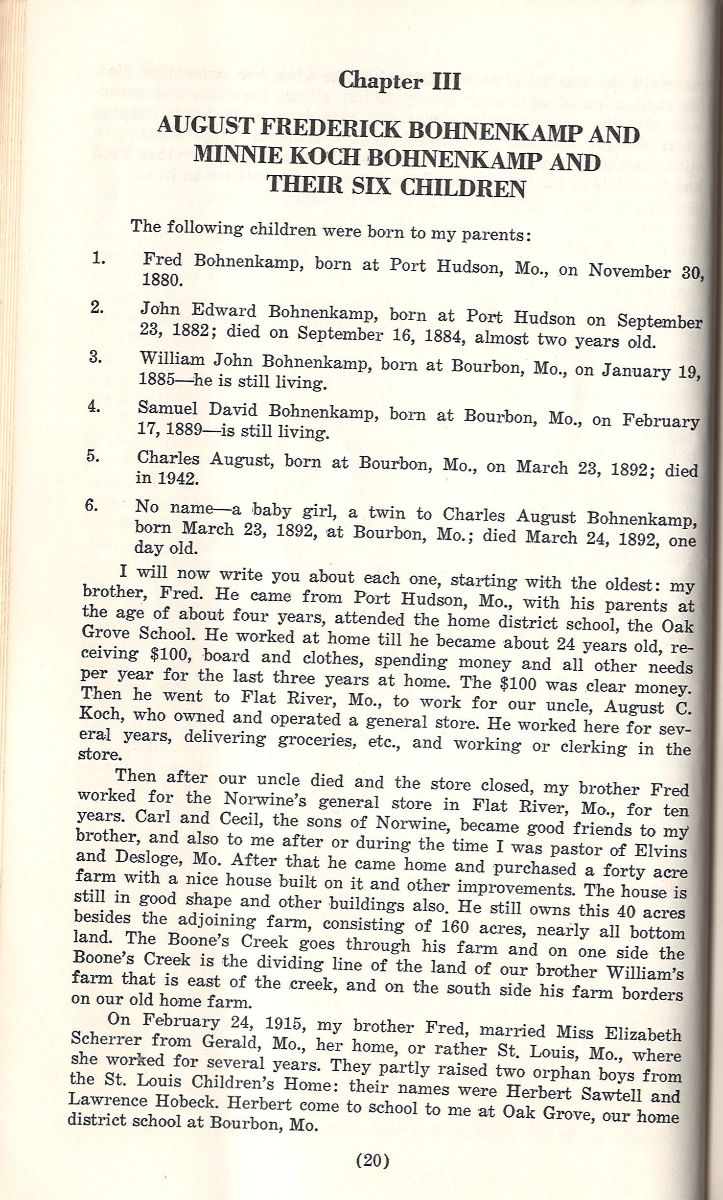
Genealogical Index to Chapter 3:
Individuals, Vital Dates, and Relationships
- Adams, Clyde: Undertaker for Charles August Bohnenkamp.
- Bacon (Family): Woodcutters who rented a home from and cleared land for William John Bohnenkamp.
- Baker, Bob: Converted at Hinch Methodist Church; husband and father.
- Bintner, Annie: From Japan, MO; early girlfriend of Sam D. Bohnenkamp.
- Blood, Rev.: Pastor who preached Charles August Bohnenkamp’s funeral.
- Blunt, J. R.: Evangelist.
- Bochawitz, Carl Edward: Born February 16, 1939. Son of Rosetta; stepson of Wilbur Bohnenkamp.
- Bochawitz, William Paul: Graduated high school in 1961. Son of Rosetta; stepson of Wilbur Bohnenkamp.
- Bohnenkamp, Amy (nee Sites): Married August 6, 1913. Wife of Sam D. Bohnenkamp.
- Bohnenkamp, August Frederick: Died February 26, 1928. Father of the six children; husband of Wilhelmina (Minnie) Koch.
- Bohnenkamp, Benjamin William: Married June 15, 1946. Oldest son of William John and Minnie Myrtle; husband of Edith Lawrence.
- Bohnenkamp, Bonnie O Neta (Reiner): Born June 4, 1925; married March 12, 1950; died October 22, 1961. Daughter of William John and Minnie Myrtle; wife of William Edward Reiner.
- Bohnenkamp, Charles August (Gussie): Born March 23, 1892; died July 10, 1942. Fifth child (twin) of August and Minnie.
- Bohnenkamp, Donald Lee: Born July 13, 1919. Married (1) Mary Jenny (divorced June 4, 1947); married (2) Laura Malone Kinsington (August 7, 1947). Son of William John and Minnie Myrtle.
- Bohnenkamp, Edith (nee Lawrence): Born May 15, 1918; married June 15, 1946. Wife of Benjamin William Bohnenkamp.
- Bohnenkamp, Fred: Born November 30, 1880; married February 24, 1915. Oldest son of August and Minnie; husband of Elizabeth Scherrer.
- Bohnenkamp, John Edward: Born September 23, 1882; died September 16, 1884. Second son of August and Minnie.
- Bohnenkamp, Louis: Half-uncle to Sam D. Bohnenkamp.
- Bohnenkamp, Lucy (Fowler): Born October 22. Youngest daughter of Sam and Amy Bohnenkamp; wife of Rev. A. J. Fowler.
- Bohnenkamp, Mary Lynn: Born May 21, 1956; christened October 14, 1956; died January 14, 1961. Daughter of Benjamin and Edith.
- Bohnenkamp, Minnie Myrtle (nee Sites): Born November 18, 1889; married March 15, 1911; died May 8, 1947. Wife of William John Bohnenkamp; daughter of William B. and Clara Sites.
- Bohnenkamp, Peggy Susan: Born April 20, 1955. Daughter of Wilbur and Rosetta.
- Bohnenkamp, Rosetta (nee Caldwell/Bochawitz): Born February 8, 1917; married May 3, 1953. Wife of Wilbur Bohnenkamp.
- Bohnenkamp, Ruth Ann: Born June 18, 1950. Daughter of Benjamin and Edith.
- Bohnenkamp, Samuel David (Author): Born February 17, 1889; born again November 15, 1926; married August 6, 1913. Fourth child of August and Minnie; husband of Amy Sites.
- Bohnenkamp, Unnamed Baby Girl: Born March 23, 1892; died March 24, 1892. Twin to Charles August; sixth child of August and Minnie.
- Bohnenkamp, Vera Clara (Troutt): Born October 29, 1914; married May 10, 1936. Daughter of William John and Minnie Myrtle; wife of David Arthur Troutt.
- Bohnenkamp, Virginia Lee: Born December 30, 1947. Daughter of Benjamin and Edith.
- Bohnenkamp, Wilbur: Born December 1, 1916; married May 3, 1953. Son of William John and Minnie Myrtle; husband of Rosetta.
- Bohnenkamp, Wilhelmina (Minnie) (nee Koch): Died April 17, 1918. Mother of the six children; wife of August Frederick.
- Bohnenkamp, William Douglas: Born January 10, 1958. Son of Wilbur and Rosetta.
- Bohnenkamp, William John: Born January 19, 1885; married March 15, 1911. Third son of August and Minnie; husband of Minnie Myrtle Sites.
- Burns, Mr. and Mrs. Orville: Neighbors of the Pinkstons.
- Bushaway, Felix: Schoolmate of Sam D. Bohnenkamp.
- Carter, Etta (nee Sites): Sister of Minnie Myrtle.
- Clayton, Earl: Steward of Leasburg Circuit.
- Coleman, Jim: Neighbor boy.
- Condon, Edward: Married June 12, 1960. Husband of Sylvia Ann Troutt.
- Condon, Unnamed Baby Boy: Born January 1, 1962. Son of Edward and Sylvia Condon.
- Crites, Dr.: Doctor at Sedgewickville, MO; former pastorate member of Sam D. Bohnenkamp.
- Enlo, Elf: Neighbor.
- Faust, Rev. John: Minister who married August and Minnie Bohnenkamp.
- Feltman, Mr. and Mrs.: Neighbors who rented a farm to William John Bohnenkamp.
- Finney, Eugene: Schoolmate of Sam D. Bohnenkamp.
- Fisher, Mr.: Sold 40 acres to William Bohnenkamp.
- Fowler, Rev. A. J.: Pastor at Elvins Methodist Church; son-in-law of Sam D. Bohnenkamp; husband of Lucy.
- Gastian, Rev. W. V.: Pastor at Bourbon Methodist Church.
- Glassey, Rev. J. L.: Minister from Williamsville; friend of Sam D. Bohnenkamp.
- Herbert, Mrs.: Rented a room to Sam and Amy Bohnenkamp in Leasburg, MO.
- Hobeck, Lawrence: Orphan boy raised by Fred and Elizabeth Bohnenkamp.
- Hume, Dr. E. L.: Doctor at Bourbon, MO.
- Hutsell, Rev.: Pastor from Kentucky.
- Jenny, Mary: Divorced June 4, 1947. First wife of Donald Lee Bohnenkamp.
- Jones, Dr.: Doctor from Piedmont, MO.
- Jones, Rev. Joseph H.: Pastor of Memorial Methodist Church (Farmington) and Stephen Memorial (Overland); wrote a poem in Jan 1952.
- Jost, John: Neighbor.
- Jowell, Miss: Evangelist from Kentucky.
- Joyce, Rev. M. G.: District Superintendent of Jefferson City District.
- Kell, Rev. Clarence: Officiating minister for Mary Lynn Bohnenkamp’s funeral.
- Kinsington, Laura Malone: Married August 7, 1947. Second wife of Donald Lee Bohnenkamp.
- Kleas, Dr. August: Civil War veteran and friend of August and Minnie Bohnenkamp.
- Koch, August C.: Uncle of Sam D. Bohnenkamp.
- Licklider, Jim: Member of Boone’s Creek Church.
- McAntosh, Mr.: Teacher at Oak Grove School.
- McMurry, Bishop W. F.: Bishop at Fayette, MO; presided over St. Louis Annual Conference at Malden.
- Meyers, Dr.: Doctor in Greenville, MO.
- Missey, Rev. M. A.: Minister from Bourbon, MO.
- Norwine: Owner of general store in Flat River, MO.
- Norwine, Carl: Son of Norwine.
- Norwine, Cecil: Son of Norwine.
- Pace, Lee: Sawmill operator.
- Pinkston, Harvey: Lead miner at Flat River, MO; husband of Mrs. Pinkston.
- Pinkston, Mrs. Harvey: Neighbor in Russell Chapel Community.
- Raines, Mrs. Sam: Dinner guest from Farmington, MO.
- Reiner, Judith Marie: Born March 18, 1951. Daughter of William E. and Bonnie.
- Reiner, Sharon Kay: Born December 9, 1952. Daughter of William E. and Bonnie.
- Reiner, Stanley William: Born October 15, 1955. Son of William E. and Bonnie.
- Reiner, William Edward: Born June 15, 1923; married March 12, 1950. Husband of Bonnie Bohnenkamp.
- Ross, Gladys (nee Sites): Sister of Minnie Myrtle.
- Ryan, Rev. H. E.: Presiding Elder of Leasburg Circuit.
- Sauerkrut, Mr. and Mrs.: Farm owners in Sullivan, MO, who boarded Dr. Kleas.
- Sawtell, Herbert: Orphan boy raised by Fred and Elizabeth Bohnenkamp.
- Scherrer, Elizabeth: Married February 24, 1915. Wife of Fred Bohnenkamp.
- Schlafer, Mary (nee Sites): Died March 31, 1939. Sister of Minnie Myrtle.
- Sevenfield, Rev.: Pastor of Bourbon Methodist Church.
- Sites, Clara: Died February 2, 1947. Mother of Minnie Myrtle.
- Sites, Evelyn: Died at age 5. Sister of Minnie Myrtle.
- Sites, Walter: Died in infancy. Brother of Minnie Myrtle.
- Sites, Wesley: Brother of Minnie Myrtle.
- Sites, Wilbur: Brother of Minnie Myrtle.
- Sites, William: Died in infancy. Brother of Minnie Myrtle.
- Sites, William B.: Died February 17, 1935. Father of Minnie Myrtle.
- Smith, Rev. and Mrs. John: Evangelists from Kentucky.
- Stickney, Rev. F. D.: Methodist minister who married William John and Minnie Myrtle.
- Summers, Ethel (nee Sites): Sister of Minnie Myrtle.
- Summers, Mrs. Harry: Dinner guest from Cuba, MO.
- Troutt, David Arthur: Born January 22, 1912; married May 10, 1936. Husband of Vera Clara Bohnenkamp.
- Troutt, Sylvia Ann (Condon): Born April 17, 1937. Daughter of David and Vera; wife of Edward Condon.
- Troutt, Vera Sue: Born June 5, 1946. Daughter of David and Vera.
- White, Frank: Neighbor at Greenville, MO.
Locations (Towns, Geography, Institutions, and Cemeteries)
Towns & Regional Locations:
- Advance, MO
- Bourbon, MO
- California (Army Camp location and Conoga Park mentioned)
- Cedar Falls, IA
- Cold Water, MO
- Cuba, MO
- Defiance, MO
- Desloge, MO
- Doniphan, MO
- Elvins, MO
- Farmington, MO
- Fayette, MO
- Flat River, MO
- Gerald, MO
- Glenwood, IA
- Greenville, MO
- Hinch, MO
- Japan, MO
- Jefferson City, MO
- Kingdom City, MO
- Kirkman, IA
- LaMonte, MO
- Leasburg, MO
- Malden, MO
- Mexico, MO
- Mineral Point, MO
- Normandy, MO (St. Louis County)
- Overland, MO
- Piedmont, MO
- Poplar Bluff, MO
- Port Hudson, MO
- Sedgewickville, MO
- Spring Bluff, MO
- Springfield, MO
- St. Clair, MO
- St. James, MO
- St. Louis, MO
- Steelville, MO
- Sullivan, MO
- Undine, MO
- West Plains, MO
- Williamsville, MO
- Wright City / Forestel / Shilo (Circuit locations)
Farms, Churches, & Specific Institutions:
- Baptist Hospital (St. Louis, MO)
- Barnes Hospital (St. Louis, MO)
- Boone’s Creek (Geography/Farm boundary)
- Boone’s Creek Church
- Bourbon Methodist Church
- Central College (Fayette, MO)
- Christian Hospital (St. Louis, MO)
- Citizen’s Bank of Bourbon
- Columbia University
- Crawford Electric Corp. (Bourbon, MO)
- Fisher Forty (Farm)
- Gibbs School House (Steelville, MO)
- Harper’s Chapel (Steelville, MO)
- Hinch Methodist Church
- Hospital No. 4 (State Hospital at Farmington, MO)
- Leasburg Circuit (Included Leasburg, Liberty, Hinch, Steelia, Harper’s Chapel, Gibbs)
- M.F.A. Milling Co. (Mexico, MO)
- Missouri University
- Mount Auburn Methodist Church (St. Louis, MO)
- Norwine’s General Store (Flat River, MO)
- Oak Grove School (Bourbon, MO – home district school)
- Paramont Cap Factory
- Phelps County Memorial Hospital
- Pilot Grove Church
- Roosman Farm
- Russell Chapel Methodist Church (Farmington, MO)
- St. Louis Children’s Home
- Stephen Memorial Methodist Church (Overland, St. Louis, MO)
- Sullivan Ring Factory
- Sunset Grill (Restaurant in Sullivan, MO)
- Temple Baptist Church (Sullivan, MO)
Cemeteries:
- Bourbon Cemetery (Bourbon, MO)
- Turner Cemetery (Located near Bourbon/Boone’s Creek area)