
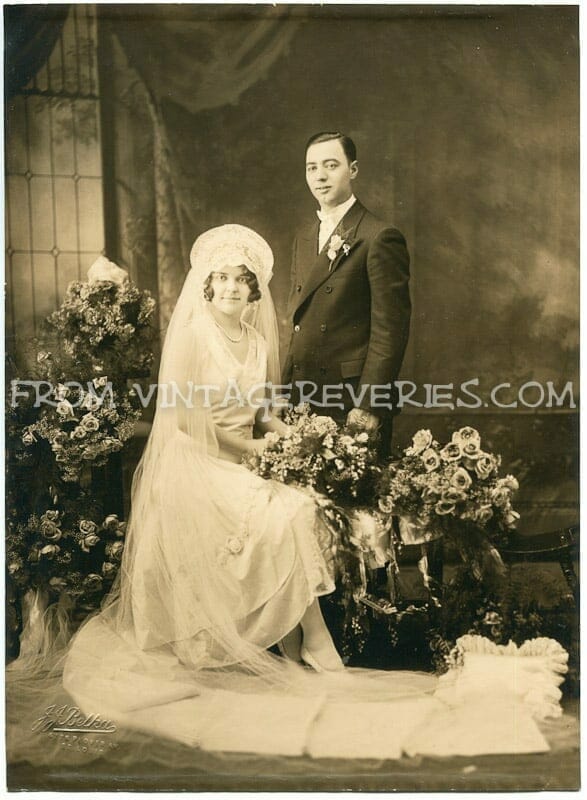
I simply cannot refuse doing favors for elderly ladies, especially when it involves carefully scanning their treasured, old family photographs. These moments capture not only their family stories, but little glimpses of history too. This particular gem is a beautiful wedding portrait from around 1912, featuring the grandmother of one such lady. It’s such a privilege to bring these images to life again—preserving them digitally while sharing the silent stories they hold.
In this wedding portrait, you can see the elegant bride adorned in what was considered the height of 1910s fashion. She is wearing a stunning single strand of pearls, symbolizing simplicity and sophistication—an accessory staple for brides at that time. Her gown is accented with delicate lace at the v-shaped neckline, an element characteristic of Edwardian-era bridal fashion. This era emphasized modesty while embracing a soft femininity in women’s style. Her long veil, attached to a lace cap-style hat, flows down gracefully, offering a touch of drama and ceremonial significance that reflects the traditions of the time.
As for the groom—he is looking quite dapper in a dark, double-breasted suit. This choice was typical for men of the Edwardian period who often wore formal morning suits or frock coats to weddings, though simpler suits like this began gaining popularity among the burgeoning middle class. His white flower boutonniere adds a touch of elegance and symbolism, representing purity and devotion.
What makes this photograph even more special is the studio that captured it. It was shot by J. J. Belka, a photographer from 4770 Plover Ave, St. Louis, Missouri. At the time, professional wedding photography was becoming increasingly accessible to middle-class families. Studios like this one often allowed newlyweds to capture themselves at their finest, preserving not only their personal story but also serving as a reflection of societal norms and customs of the time.
To paint a slightly broader picture of the period, the early 1910s represented a time of visible transformation in both America and Europe. It was an era of great innovation, progress, and change—automobiles were just becoming mainstream, silent films were captivating imaginations, and the Titanic disaster of April 1912 loomed large in that same year. The Edwardian period, during which this photograph was taken, was coming to a close, and soon the world would be entering the tumultuous years of World War I. Yet, for this couple, their wedding day in 1912 was likely a moment of personal joy amid a simpler, slower-paced existence compared to today.
When I look at this photograph, I imagine the excitement and love that brought this young couple together. What were their dreams? How did they meet? What did their lives look like beyond this perfect snapshot in time?
The photo’s details give subtle hints about its era and the couple’s life. The well-fitted clothing and the formal studio setting suggest they came from a family of moderate means—likely working or middle class—affording them the luxury of beautifully documenting their special day. This is preserved in the careful pose and lighting emblematic of early 20th-century portrait artistry.
Preserving and sharing these images is my small way of connecting past to present—breathing new life into the memories of long-gone lives and fashion. This isn’t merely a photo; it’s a fragment of history, a reflection of a specific time, place, and culture.
What stands out most about 1910s fashion is how it bridges Victorian constraints with the coming 1920s revolution in style. The Edwardian silhouette—a softer refinement of the dramatic Victorian hourglass shape—symbolized a society slowly loosening rigid norms. By 1912, women’s gowns, especially for brides, began embracing lighter, more flowy materials such as silk and chiffon, often decorated delicately with lace and embroidery. Still, dresses were modest, typically featuring high necklines and long trains, which conveyed both purity and grace.
The little details in this photograph, from the pearls to the lace to the veil, offer a glimpse into this beautiful and transitional era. Looking at it, we’re not only reminded of one couple’s love story but also of a brief moment in history when the world was changing yet traditions still held strong.
So here it is—a precious snapshot from 1912, frozen in time and now available for future generations to admire and study.
Let’s never take these relics of the past for granted. While they may simply appear as ink on paper or pixels on a screen, they are silent witnesses to eras, traditions, lives, and moments that paved the way for where we are today.
