
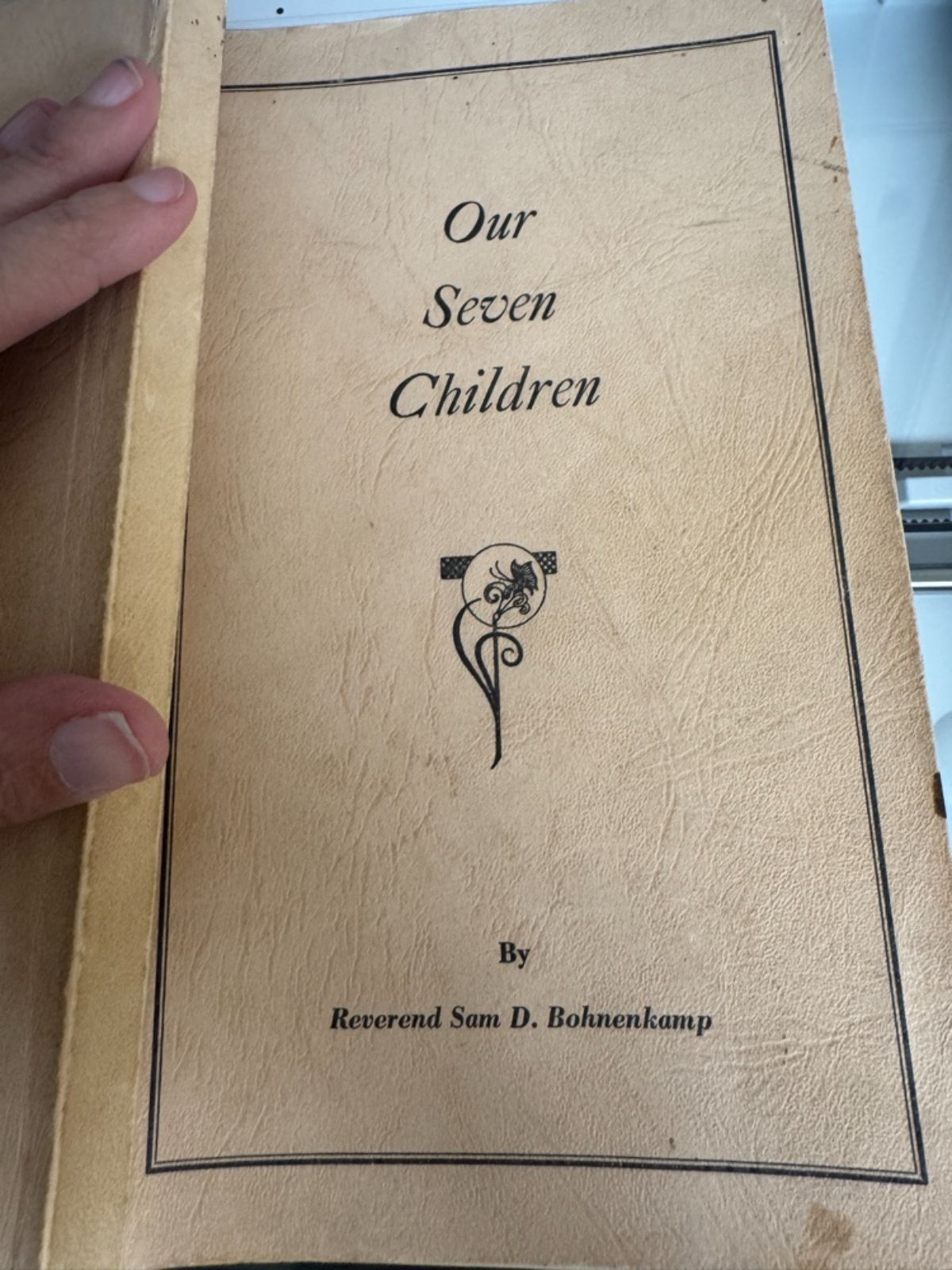
Yesterday, I scanned a 220-page family history book that has been sitting in my possession for years.
Not because it is polished. Not because it is famous. Not because some archivist carefully selected it as “important.”
But because it exists.
And because, as far as I can tell, almost no one else has made it available.
The book is called Our Seven Children, written by Reverend Sam D. Bohnenkamp, a retired Methodist minister born in Bourbon, Missouri, in 1889. He lived until 1983, which means his life stretched across an almost ridiculous span of American history: horse-and-wagon childhood, cholera memories passed down from immigrant grandparents, rural Missouri farms, World Wars, church cemeteries, St. Louis brick yards, family tragedies, sausage shortages, barefoot creek-running, and eventually the modern world that must have seemed both miraculous and completely insane.
I grew up hearing about “Uncle Sam” Bohnenkamp.
Like a lot of family characters, the stories were never entirely simple. He was remembered as quite a character — for good, for bad, and probably for all the messy human reasons that never fit neatly into one sentence. But he wrote this book. And whatever else he was, he left behind something rare: a long, wandering, deeply personal memory dump from a man who was trying to preserve his family before time swallowed the details.
And time absolutely does swallow the details.
It swallows maiden names. It swallows second marriages. It swallows babies buried in cemeteries whose markers are gone. It swallows the reason someone left Germany, the name of the farm, the story behind the church, the exact relationship between one “Aunt Tilly” and the child who remembers wanting another piece of sausage at breakfast.
This book is not just genealogy. It is social history.
It is immigrant history. Missouri history. Rural history. Church history. Working-class St. Louis history. Family history written in the voice of someone who was not trying to sound literary or academic. He was just trying to get it down.
And honestly, that is what makes it fascinating.
It reads like memory actually works: repetitive, specific, sentimental, opinionated, sometimes funny, sometimes abrupt, sometimes heartbreakingly matter-of-fact. A woman dies of cholera at twenty-nine. A child works out in homes. A man accidentally burns a ten-dollar bill in the stove. A barefoot country boy cannot understand why his city cousin’s feet are so soft. A lost grave is mentioned almost in passing, because what else can you do with grief after a hundred years except write it down and keep moving?
The physical book itself was hard to scan. It is small, tightly printed, and has narrow margins that seem designed to make a modern scanner weep. I used a combination of manual scanning, image cleanup, and AI-assisted text extraction through a Google Apps Script I wrote to help pull readable text from the JPEGs. So yes, this is part history project, part family project, part preservation project, and part “why do I do this to myself?” project.
But that is kind of the whole Vintage Reveries thing, isn’t it?
Old things do not preserve themselves.
Somebody has to care enough to do the tedious part.
As I work through the book, I’ll be sharing chapter excerpts, OCR passages, notes, corrections where I can make them, and personal reflections along the way. My plan is to eventually upload the finished formatted version to Archive.org and FamilySearch once it meets their requirements. The raw, unedited scans are already available in the Vintage Reveries members download area, and I’ll also offer a cleaned version in my downloads section for a small fee to help support the time and labor involved in making these materials available.
But the bigger purpose is simple:
I want this book to be findable.
For descendants. For researchers. For local historians. For the random person Googling a great-great-grandparent’s name at 1:00 a.m. and wondering why no one ever wrote any of this stuff down.
Well, Reverend Sam did.
And now I’m bringing it back into the light.
Series Introduction: Reading Our Seven Children by Reverend Sam D. Bohnenkamp
This post begins a new Vintage Reveries series documenting and transcribing Our Seven Children, a family history memoir written by Reverend Sam D. Bohnenkamp and originally published around 1962.
The book opens with the Bohnenkamp family’s German immigrant roots: John Phillip Bohnenkamp, his wife Mary Beckman Bohnenkamp, and their two young children, August Frederick and Mary, who came to America in 1853. Within weeks of arriving in St. Louis, Mary died during a cholera epidemic at only twenty-nine years old, leaving two small children motherless in a new country.
From there, Reverend Sam traces the family through St. Louis, Omaha, Port Hudson, Bourbon, Franklin County farms, church cemeteries, remarriages, stepchildren, half-siblings, cousins, ministers, laborers, farmers, dressmakers, and children who died young.
It is a lot.
And that is exactly why I love it.
This is not a sleek modern genealogy with tidy citations and clean formatting. It is a living memory document. Reverend Sam writes the way people remember: circling back, repeating details, inserting letters, pausing to explain cholera, jumping from farm abstracts to family breakfasts to cemetery inscriptions to who married whom and where they are buried.
There is something deeply human about that.
He is not just listing names. He is trying to hold onto people.
In Chapter I, “The Bohnenkamps,” we meet several branches of the family, including the Kettenbrinks, Koppelmans/Kappelmans, Beckers, Elebrakes, and others connected through marriage, migration, work, and church life. We also get glimpses of St. Louis during the nineteenth century, the German immigrant community, cholera’s devastating impact, and the way families survived through remarriage, labor, farming, and mutual obligation.
I’ll be posting these passages in sections because the book is long, dense, and honestly deserves room to breathe. Where possible, I’ll preserve Reverend Sam’s original wording, punctuation, spelling, and rhythm, while also noting obvious OCR issues or places where names may need verification.
Because this is the thing about old family books: they are precious, but they are not perfect.
Names shift. Dates conflict. Cemetery names are misspelled. Memories compress time. A person writing in 1962 about events from the 1850s is working with family stories, documents, memory, and whatever records he could personally access.
That does not make the book less valuable.
It makes it more human.
So this series is partly transcription, partly archive work, partly family history, and partly me sitting with the strange intimacy of reading an ancestor-adjacent relative’s voice decades after he sat down and decided, “I will try by the help of God to write this book.”
And now, all these years later, I’m trying by the help of scanners, scripts, stubbornness, and caffeine to make sure people can read it again.
Intro to Chapter I – The Bohnenkamps
Today I’m sharing the opening portion of Chapter I of Our Seven Children by Reverend Sam D. Bohnenkamp.
This first chapter begins with the Bohnenkamp family’s arrival from Germany in 1853 and quickly moves into one of the defining tragedies of the family: the death of Mary Beckman Bohnenkamp during a cholera outbreak in St. Louis, leaving her two small children, August Frederick and Mary, motherless shortly after arriving in America.
From there, Reverend Sam follows the family through St. Louis, Omaha, Port Hudson, Franklin County, and several connected family lines. It is part genealogy, part memoir, part rural Missouri history, and part old-fashioned family storytelling — the kind where one paragraph contains a land abstract and the next contains a memory of wanting more sausage at breakfast.
I have preserved the text as closely as possible while cleaning up obvious OCR errors. Because this project is still in progress, corrections and family notes are very welcome.
OCR Transcription of prologue and Chapter I – The Bohnenkamps
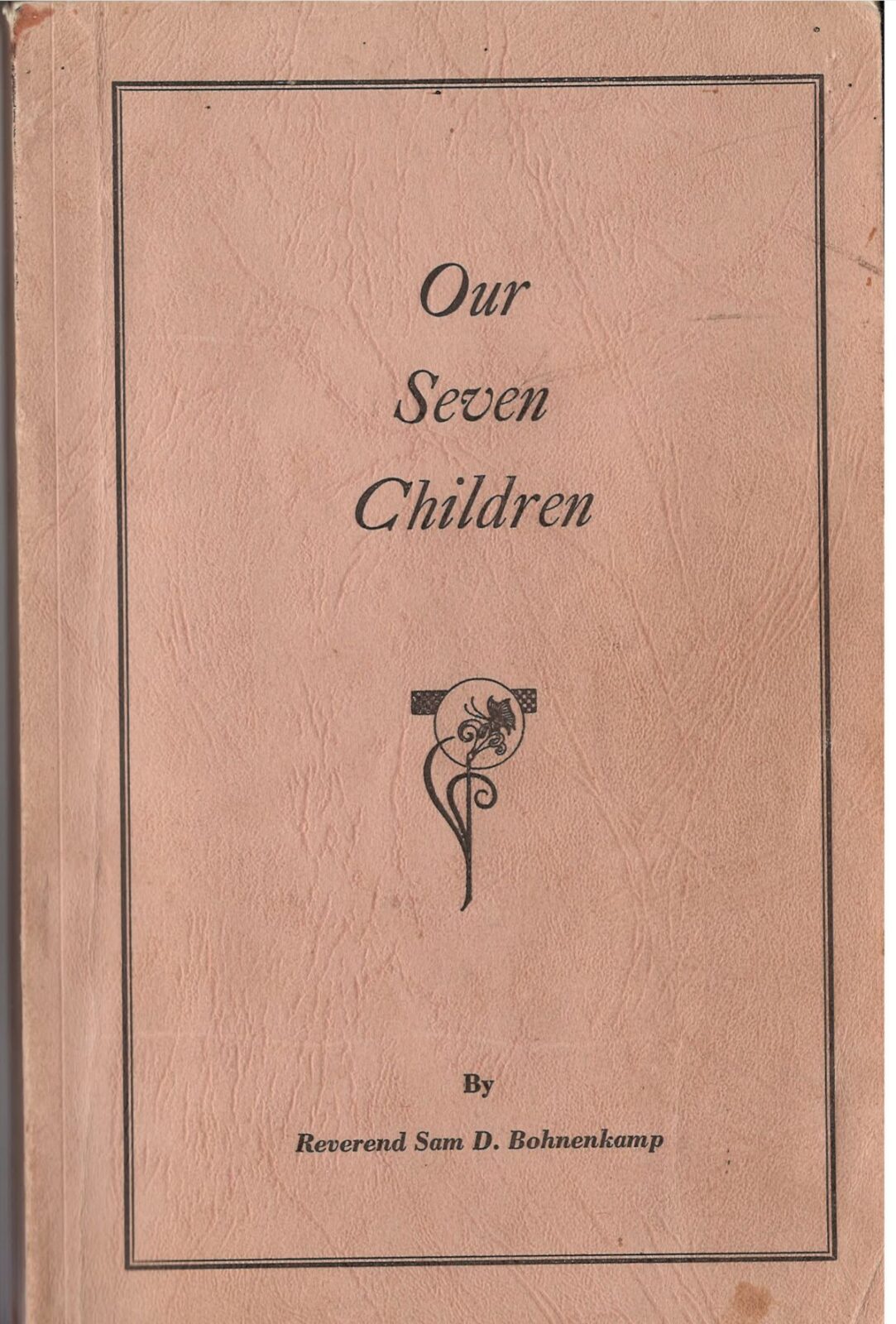
Our Seven Children – by Rev. Sam D. Bohnenkamp
PRICE OF THIS BOOK $5.00 EACH
Title of This Book:“OUR SEVEN CHILDREN”
I dedicate this Book
To My Beloved Wife, Amy Sites Bohnenkamp
TO WHOM IT MAY CONCERN:
I, nor any of the co-writers of this book will not be responsible for any item, date, statement or names used in this book. We have done our best to give information, Episodes, Sermons, poems, letters, etc., all to interest people and edify one another and all for the Glory of God to build up the Kingdom of God on this earth and this world and the World to Come—.
REV. SAM D. BOHNENKAMP
701 Kansas St.
Farmington, Mo.
Index to this Book is as Follows:
CHAPTER I The Bohnenkamps
CHAPTER II The Kochs
CHAPTER III August Frederick Bohnenkamp and Minnie Koch Bohnenkamp and their Six Children
CHAPTER IV The Sites’
CHAPTER V Sam D. Bohnenkamp and his wife, Amy
CHAPTER VI My Appointments in the Methodist Church
CHAPTER VII Our Seven Children starting with our oldest child, Alice May
CHAPTER VIII The Second Oldest, Mildred Marie
CHAPTER IX The Third Oldest, Earl
CHAPTER X Our Fourth Oldest, Clara
CHAPTER XI Our Fifth Oldest, Henry
CHAPTER XII Our Sixth Oldest, Marvin
CHAPTER XIII Our Seventh Oldest, Lucy
CHAPTER I The Bohnenkamps
To whom it may concern: I, Rev. Sam D. Bohnenkamp, Methodist Minister (retired) was born February 17, 1889 at Bourbon, Mo. Age now: 71 years and 3 days old.
I will try by the help of God to write this book: “Our Seven Children.”
John Phillip Bohnenkamp, my grandfather, was born in Germany in 1809. In 1853, he with his wife, Mary, and two small children, namely: August Frederick, two and a half years old, and Mary, six months old, came to America (New York) on a boat and then settled in St. Louis, Mo., where my grandfather found employment.
He then lost his wife in one of the Cholera epidemics and buried her in Zion Cemetery, St. Louis, Mo. She was only twenty nine years old. So that left my father and his little sister orphans, so grandfather Bohnenkamp took the little children to their grandparents, the Beckmans, at Omaha, Nebr., where their grandfather Beckman was an Evangelical Lutheran Minister. In this Beckman home they stayed over three years, then in 1856 my grandfather, John Phillip Bohnenkamp, went to Port Hudson, Mo., and homesteaded 80 acres. I read the abstract at the courthouse abstract office at Union, Mo., the county seat of Franklin County, which reads: John Phillip Bohnenkamp, United States, September 18, 1856—Entry 80 acres. Later he purchased 40 acres more just west of his 80 acres, making a 120 acre farm.
Right after he homesteaded the 80 acres, he got married to Mrs. Mary Koppelman, a widow who had lost her husband, and had two children, which he left with their grandparents, the Beckmans. And now he had four children to care for—and soon to this union were born five children, namely: Louis, Louise, Anna, Minnie, and Fred. Consequently they had a family of nine children. They had a difficult time making a living, so my father, August Frederick Bohnenkamp, being the oldest of the nine children, helped them out till he became 24 years old—then he bought 80 acres joining north of his father’s farm. He cleared up this farm, built a log house and six years later got married to my mother. So Mary Bohnenkamp, being the next to my father in age, helped out a lot in the home until, in her teens, she was old enough to go to St. Louis, Mo., where she worked out in homes, saved her money, and met August Kettenbrink, and married him.
I will now try and write about my father’s only full sister, two and one half years younger than my father. She was also born in Germany, January 15, 1851. My father (her only full brother) was born June 29, 1849 in Germany, too. These two children came with their parents from Germany on a boat, landed in New York, N.Y., on June 15, 1853. From New York they came to St. Louis, Mo., where my grandfather Bohnenkamp found employment. During the month of July, 1853, my grandmother Bohnenkamp took the cholera and died within a few days. They buried her in Zion Cemetery, St. Louis, Mo. My grandmother, Mary Beckman Bohnenkamp, was only 29 years old when she died from the cholera.
May I digress here, for a few lines. I wanted to know something about the disease that killed my grandmother and thousands of others. So I wrote a letter to S. C. Slaughter, M.D., Fredericktown, Mo., and the following are letters I received from him regarding this disease:
March 5th, 1960
Rev. Sam D. Bohnenkamp Farmington, Mo.
Dear Friend:
The correct spelling you asked for is Cholera, this is an acute infectious disease, chiefly epidemic, coming on from one to six days after infection, (usually two or three). Symptoms are cramps, Diarrhea, large watery stool with mucus and blood. The patient usually dies in one to four days, with present treatment many could be saved. The infection is from drinking water. I think your time of the Epidemic is about right, however I will have my son-in-law obtain the exact date and will let you know within a week or ten days at the latest. My son-in-law is a Doctor, M.D., practicing in Creve Coeur, which is in the county just outside of St. Louis. October 8th, I fell, broke my hip, have been able to go to the office in the afternoon since February 8th, but am not able to make any calls, but hope to by April first. With kindest regards to yourself and family.
Very respectfully,
S. C. Slaughter.
The following letter followed from S. C. Slaughter, M.D.
March 12th, 1960
Rev. Sam D. Bohnenkamp Farmington, Mo.
Dear Friend: The year of the Cholera Epidemic in St. Louis was 1849. This has been reported as the most severe Cholera Epidemic ever had in Missouri. With kindest personal regards,
Yours sincerely,
S. C. Slaughter, M.D.
My grandfather, John Phillip Bohnenkamp, now left a widower with two young children, Mary, 2 years and six months old and August Frederick, about five years old, took them to their grandparents, Rev. and Mrs. Beckman, Omaha, Nebraska, where my great-grandfather was an Evangelical Lutheran Minister. Here the children stayed about four years in this Christian home of their grandparents—till their father, John Phillip Bohnenkamp, married again at Port Hudson, Mo., where he homesteaded a farm and lived there the rest of his life.
Here the children stayed until they were old enough to work out. They went to St. Louis to work. Here it was where my father palled with a young man named August Frank Kettenbrink. August Frank Kettenbrink was born in Kreis Luefke Unter Den Linden, Germany on August 28, 1851. He came to St. Louis, Mo., at the age of about twenty one years old. He died May 28, 1923, and was buried in Zion’s Evangelical Cemetery in St. Louis, Mo. His religion: Evangelical.
As these two young men chummed together—my father working at the brick yards in south St. Louis, and August Frank Kettenbrink working in the pottery factory in Carondolet, East St. Louis, Illinois—going across the bridge to work. Here he held down this job about all his working days.
In this way my aunt Mary Bohnenkamp met this young man and they were married on April 23, 1875 at St. Louis, Mo. Eight children were born to them as follows:
- Emma, born February 15, 1875 at St. Louis, Mo.; married William Gouding on September 17th, 1900; died August 5, 1955; buried in Zion Evangelical Cemetery. Four children were born to the Goudings as follows: Mildred, Wilford, Elmer and Helen. Wilford passed away at the age of fourteen years. Evangelical religion.
- Henry, born August 25th, 1878 at St. Louis, Mo.; died September 19, 1892; buried in Zion Evangelical Cemetery. He attained the age of fourteen years. Evangelical religion.
- Minnie Mary, born February 1880, at St. Louis, Mo., died in March 1884; buried in Zion Evangelical Cemetery; attained the age of four years. Evangelical religion.
- Fred Gotlief Kettenbrink, born January 12, 1882, at St. Louis, Mo.; died May 26, 1957; married June 16, 1909 to Florence Newel. Five children were born to them as follows: Hazel, Raymond, Florence, Virginia, and Fred, Jr. All are living and married. Hazel has one daughter (Lutheran religion); Florence has two daughters and one son, Lutheran religion. Raymond has no children. Lutheran Religion. Virginia has three daughters. Catholic religion. Fred, Jr., has two daughters. Catholic religion. The parents of these five children are both dead.
- Mathilda Caroline Marie Kettenbrink, born May 15, 1884 at St. Louis, Mo.; not married; very active, working every day at the same place for fifty one years. Unity religion.
- Edwin Louis Kettenbrink, born January 22, 1887 at St. Louis, Mo., married to Addie Marie Schorge, on June 3, 1914 at Salisbury, Mo. They have two boys—Edwin Carl and Aubert Richard. Edward Carl has one son and Aubert. Richard has two sons and one daughter. Evangelical religion. If I understand it correctly one of these boys is an Evangelical Minister.
- August, born March 14, 1890, at St. Louis, Mo.; married to Edna Watkins in January, 1921; they have one daughter, Edna. Edna has three sons. August passed away October 5th, 1938; buried in Pickots Evangelical Cemetery. Evangelical Religion.
- Delia Lydia Marie Kettenbrink, born July 16, 1895 at St. Louis, Mo.; died December 21, 1954; married to Walter Feldmann on June 22, 1921, who passed away on November 15, 1955. Have one son, Walter, Jr., who resides in Denver, Colorado. He has one daughter. All Evangelical religion.
The Kettenbrinks came often to visit us on the farm at Bourbon, Mo., especially during the summer. I remember Mathilda Caroline Marie Kettenbrink would do a lot of sewing for my mother. The sweat would just pour from her face as she kept sewing constantly—she always was faithful to her work. No wonder she still holds down her job after 53 years, and is still very active. I think she owns the old home house that her father and mother owned for so many years. Affectionately everyone called her “Tilly.” She always boarded at home and was with her parents until they passed away.
I remember when I was four years old my mother and my youngest brother, who was just a baby, and I visited in their home. They would have just one piece of sausage each for breakfast and I wanted another piece, but there just wasn’t any left. I could not understand just why, but they tried to tell me it took money to buy sausage. I always liked lean pork sausage and lean ham meat and even do today—I take a ham sandwich when I eat out or am on vacation.
I remember my uncle August Frank Kettenbrink sent one of their older children to borrow $10.00 from my half uncle, Louis Bohnenkamp, who was well to do financially, being a carpenter, and who lived close to the Kettenbrinks. So they put the ten dollar bill in a paper sack on the shelf by the heating stove and the next morning when my uncle Kettenbrink was making a fire in the heating stove and needed some paper to light the fire with, he just took the paper sack and lit a match to it and started the fire off in the heating stove. But Oh! when he discovered what had happened to the ten dollar bill he had to send for another ten dollar bill to get some groceries.
I remember my cousin, Edwin Louis, came to visit us on the farm and I was barefooted—all the country boys and girls went barefooted in those days, it saved buying shoes and it really was cooler during the summer months. I was about ten years old and my cousin went with me to get up the cows to milk and the cows went through a woods and I ran right through the woods, sticks and rocks, gravel and what not, to get the cows home. So my cousin said, “I just don’t understand how you can go barefooted and not hurt your feet.” I said, “Oh; No: My feet are calloused.” So when we went swimming in the Boone’s Creek, I could go all over the creek’s gravel and my cousin had to wear old shoes or just sit down or try to walk a little at a time.
I think the city boys and girls are softer in some ways than the country boys and girls.
After I was a young man I visited in the home of the Kettenbrinks and Edwin was so kind to me and took me all over St. Louis, Mo., and took me to places of interest, theatres and etc.
One time Delia came with her mother and stayed a week with us on the farm. Delia was lively and lots of fun, so we played together and had a good time.
Then John Kampelman married and lived on a farm near Fort Hudson, Mo. After this Mary Koppelman got married to a man that lived in Kansas—they had two children and she died young. We lost track of the two children and her husband in Kansas—probably his parents raised them up, etc.
Then Louis Bohnenkamp left home in his teens. He became a carpenter, went to St. Louis and married and became wealthy. To this union were born Lula, Fred, Louis, Leslie, Robert and Fillmore.
My half uncle, Louis Bohnenkamp, gave each of his children a house in Walnut Park, St. Louis, Mo., when they got married. He died a few years ago and left over $100,000 in money, real estate and home, etc. I used to visit him and have prayer with him. He was very courteous and kind. He and his wife used to come to see my parents as well as the children to visit us. One time my uncle Louis, came in the winter to help my father build a large barn with corn crib, hay loft, above, with drive in on floor, with machinery shed by the drive in. The ground was covered with snow and very cold. So, he wrapped up his feet in toe sacks, built a fire where they were working in the barn and the barn went up regardless of the weather. My half aunt, uncle Louis Bohnenkamp wife’s name was Charlotte. We called her Aunt “Lottie.” She was born 1857, died 1945, a native of St. Louis, Mo., buried in the Zion Cemetery, St. Louis, Mo.
Filmore Bohnenkamp died in April, 1962. He leaves one brother, Robert and one sister, Lula. He was the son of Mr. and Mrs. Louis Bohnenkamp of St. Louis, Mo.
Kettenbrink, Mathilda C., died Saturday, August 11, 1962, dear sister of Edwin L. Kettenbrinck and the late Emma Gauding. Delia Feldman, Fred and Gus Ketenbrinck, dear aunt of Walter C. Feldman, dear sister-in-law. Aunt, Great aunt and cousin. Funeral, Wednesday, August 15, 10:00 a. m. from Math Herman and Son’s Chapel, Fair and West Florissant Avenues. Interment Zion Cemetery. Miss Kettenbrink was a member of Unity Christ Church. Loyal Council No. 8D, of A. and United Garment Workers Union Local No. III. She was 78 years old.
Then a daughter was born to them, Louise. She married Fred Becker, Gerald, Mo. They owned a large farm on the Boeff Creek, lots of bottom land. They had two children and made lots of money on this farm. After their death their son, Bill Becker, inherited this farm. Bill’s sister inherited her part in money.
Then Anna was born to them. She died with the small pox when she was five years old.
Then Minnie was born to them. She married Henry Elebrake, Gerald, Mo. They owned a nice rich farm on the Red Oak River. To this union the following children were born: Minnie Kathryn born Elebrake on April 19, 1861, died May 17, 1918.
Henry William was born April 25, 1857, died February 18, 1928. He died in the service of his country, World War I. The Government of Uncle Sam put up a beautiful monument for him on the Red Oak Methodist Church Cemetery, Gerald, Mo.
The next child born to my Aunt and Uncle Henry Elebrake was Alice, born March 2, 1886, died in the summer of 1904.
The next born was Fred Elebrake, Oct. 22, 1887, died June 7, 1930. He was married. Fred had the call from God to become a Methodist Minister when a young man at home. His father objected for him to become a Methodist preacher. Said: “He did not want any of his children to become beggars,” knowing how hard a time the preachers had in raising the church funds—especially in those days. So, Fred went to St. Louis, Missouri and became a banker, working in the bank the rest of his life, dying a young man, being less than forty three years old.
The next born to my Aunt and Uncle Henry Elebrake was Emma Amanda, born October 8, 1891. She was married to Mr. Brandhorst, November 18, 1918.
The next was John Charles, born February 17, 1894.
The next was Alma Louise, born February 1, 1897, died January 19, 1946. She was married to John Brandt. They had two children born to them, Mildred, who died 1929 and a son, Clinton Brandt, born 1923, still living.
Then the last child born to my Aunt and Uncle Henry Elebrake was Otto John, June 1902. He lost his wife by death, February 10, 1942, leaving several small children which Otto their father raised up without being married again. One of the boys is an Evangelical Lutheran Minister in another state north.
Before my grandfather Bohnenkamp had all these children raised up his wife died, which would be my step-grandmother. They buried her in the Evangelical Lutheran Cemetery at Port Hudson, Mo., and her grave got lost. No marker was put up.
During all this time my grandfather, John Phillip Bohnenkamp, became a Methodist and was one of the eight persons, Charter Members, who built the Salem M. E. Church (Casco) Port Hudson, Mo., in 1871 by the Rev. John Meyer, Methodist Minister being pastor.
This church house is built of rock and is in good shape today. The building like the Leslie Beaufort, Mo., Rock Church. So both of my grandfathers built or helped build rock Methodist Churches.
In the Blue Book “Who Is Who”, the name of my grandfather, John Phillip Bohnenkamp, is recorded as an outstanding citizen of his State of Missouri. This church is about one mile east of his farm or the old Bohnenkamp Homestead Farm.
Here his son, Fred, inherited the 120 acre farm for keeping my grandfather, John Phillip Bohnenkamp, until he died in 1885. Se was born in Germany, 1809. He was about 76 years old and the loved ones buried him right close in back of the rock church he helped build and loved so much to attend the services. Here his son’s family, Fred, attended too. Fred had four daughters namely: Lydia, Annie, Emma and Malinda. These girls walked across the fields to attend church and Sunday School. Here they were confirmed. Receiving religious instructions from their pastor.
My Aunt Louise Bohnenkamp was born in 1964, died in February, 1955. My Uncle Fred Bohnenkamp, was born in 1859 and died in 1931. They are buried side by side close to grandfather’s grave. They all have beautiful monuments erected on their graves. Here they sleep in back of the church cemetery with other neighbors and friends waiting for the resurrection morning to come forth out of their graves to meet our Lord and Saviour, Jesus Christ.
Before my grandfather, John Phillip Bohnenkamp, died he made a will. I read this will a few months ago, going to the abstract office near the court house across the street at Union, Missouri, Franklin County. I copied the will and it reads as follows: “I, John Phillip Bohnenkamp, will to my son, Frederick William Bohnenkamp, my farm consisting of 120 acres. (Here was the land described). Then he wrote, All my horses, cattle, hogs, sheep, wagons, machinery of all kinds, wheat, corn, hay, etc., as well as utensils and house, and kitchen furniture, upon the condition that he pay all my just debts as funeral expenses, doctor bills and all other indebtedness, and pay the remainder of my heirs below mentioned the following.
- To my son, August Frederick Bohnenkamp, the sum of $25.00
- To my son, Louis Bohnenkamp, the sum of $25.00.
- To my stepson, John Kappelman, the sum of $10.00.
- To my daughter, Mary Bohnenkamp, the sum of $25.00.
- To mydaughter, Louise Bohnenkamp, the sum of $25.00.
- To my daughter, Wilhelmina (Minnie) Bohnenkamp, the sum of $25.00.
The above will was made June 14, 1886. The farm is now sold to some outsider, a man from St. Louis, Missouri. The old house was burned down—struck by lightning about five years ago.
Gallery of book scans from this chapter:


Genealogical Index: Our Seven Children, Chapter I
Full Names & Vital Dates
- Aubert Richard Kettenbrink: (No dates); son of Edwin Louis and Addie.
- Addie Marie Schorge: Married June 3, 1914; wife of Edwin Louis Kettenbrink.
- Alice May Bohnenkamp: (No dates); oldest child of Sam and Amy Bohnenkamp.
- Alma Louise Elebrake: born Feb 1, 1897; died Jan 19, 1946; daughter of Minnie and Henry.
- Amy Sites Bohnenkamp: (No dates); wife of Sam D. Bohnenkamp.
- Anna Bohnenkamp: (No dates); died age 5 (smallpox); daughter of John Phillip and Mary (Koppelman).
- August Bohnenkamp: born June 29, 1849; son of John Phillip and Mary (Beckman).
- August Frederick Bohnenkamp: born June 29, 1849; son of John Phillip and Mary (Beckman).
- August Kettenbrink: born March 14, 1890; died Oct 5, 1938; son of Mary and August Frank.
- August Frank Kettenbrink: born Aug 28, 1851; died May 28, 1923; husband of Mary Bohnenkamp.
- Clara Bohnenkamp: (No dates); fourth child of Sam and Amy.
- Clinton Brandt: born 1923; son of Alma and John Brandt.
- Delia Lydia Marie Kettenbrink: born July 16, 1895; died Dec 21, 1954; daughter of Mary and August Frank.
- Earl Bohnenkamp: (No dates); third child of Sam and Amy.
- Edna Watkins: Married Jan 1921; wife of August Kettenbrink.
- Edwin Carl Kettenbrink: (No dates); son of Edwin Louis and Addie.
- Edwin Louis Kettenbrink: born Jan 22, 1887; son of Mary and August Frank.
- Emma Amanda Elebrake: born Oct 8, 1891; daughter of Minnie and Henry.
- Emma Kettenbrink: born Feb 15, 1875; died Aug 5, 1955; daughter of Mary and August Frank.
- Filmore Bohnenkamp: died April 1962; son of Louis and Charlotte.
- Florence Newel: Married June 16, 1909; wife of Fred Gotlief Kettenbrink.
- Fred Bohnenkamp: born 1859; died 1931; son of John Phillip and Mary (Koppelman).
- Fred Elebrake: born Oct 22, 1887; died June 7, 1930; son of Minnie and Henry.
- Fred Gotlief Kettenbrink: born Jan 12, 1882; died May 26, 1957; son of Mary and August Frank.
- Henry Bohnenkamp: (No dates); fifth child of Sam and Amy.
- Henry Kettenbrink: born Aug 25, 1878; died Sept 19, 1892; son of Mary and August Frank.
- Henry William Elebrake: born April 25, 1857; died Feb 18, 1928; husband of Minnie Bohnenkamp.
- John Charles Elebrake: born Feb 17, 1894; son of Minnie and Henry.
- John Phillip Bohnenkamp: born 1809; died 1885; patriarch.
- Louis Bohnenkamp: (No dates); son of John Phillip and Mary (Koppelman).
- Louise Bohnenkamp: born 1864; died Feb 1955; daughter of John Phillip and Mary (Koppelman).
- Lucy Bohnenkamp: (No dates); seventh child of Sam and Amy.
- Marvin Bohnenkamp: (No dates); sixth child of Sam and Amy.
- Mary Bohnenkamp: born Jan 15, 1851; daughter of John Phillip and Mary (Beckman).
- Mary Beckman Bohnenkamp: died July 1853 (age 29); first wife of John Phillip.
- Mary Koppelman Bohnenkamp: (No dates); second wife of John Phillip.
- Mathilda Caroline Marie Kettenbrink: born May 15, 1884; died Aug 11, 1962; daughter of Mary and August Frank.
- Mildred Marie Bohnenkamp: (No dates); second child of Sam and Amy.
- Minnie Kathryn Elebrake: born April 19, 1861; died May 17, 1918; wife of Henry Elebrake.
- Minnie Mary Kettenbrink: born Feb 1880; died March 1884; daughter of Mary and August Frank.
- Otto John Elebrake: born June 1902; son of Minnie and Henry.
- Rev. Sam D. Bohnenkamp: born Feb 17, 1889; author and grandson of John Phillip.
Locations
- Boeff Creek: Site of Fred Becker’s farm near Gerald, MO.
- Boone’s Creek: Local swimming spot near the Bohnenkamp farm.
- Bourbon, MO: Birthplace of Rev. Sam D. Bohnenkamp and site of family farm.
- Creve Coeur, MO: Practice of Dr. Slaughter’s son-in-law.
- Farmington, MO: Residence of Rev. Sam D. Bohnenkamp (701 Kansas St.).
- Fredericktown, MO: Residence of Dr. S.C. Slaughter.
- Gerald, MO: Residence of the Becker and Elebrake families.
- Omaha, NE: Home of the Beckman grandparents.
- Port Hudson, MO: Site of the Bohnenkamp homestead and Salem M.E. Church.
- Red Oak River: Site of the Elebrake farm.
- St. Louis, MO: Initial settlement site; location of various family deaths and brickyards.
- Union, MO: County seat of Franklin County (site of courthouse/abstract office).
- Walnut Park, St. Louis: Neighborhood where Louis Bohnenkamp provided homes for his children.
- Cemeteries:
- New Rock (Salem M.E. Church) Cemetery: Port Hudson, MO.
- Pickots Evangelical Cemetery: Burial place of August Kettenbrink.
- Red Oak Methodist Church Cemetery: Gerald, MO.
- Zion Cemetery / Zion Evangelical Cemetery: St. Louis, MO.
Relationships
- John Phillip Bohnenkamp: Married 1st Mary Beckman; married 2nd Mary Koppelman.
- August Frederick Bohnenkamp: Son of John Phillip and Mary Beckman; brother of Mary.
- Mary Bohnenkamp Kettenbrink: Daughter of John Phillip and Mary Beckman; wife of August Frank Kettenbrink.
- Louis, Louise, Anna, Minnie, and Fred Bohnenkamp: Children of John Phillip and Mary Koppelman.
- John Kappelman: Stepson of John Phillip Bohnenkamp.
- The Beckmans: Parents of Mary Beckman; grandparents to August and Mary.
- Rev. Sam D. Bohnenkamp: Son of August Frederick Bohnenkamp; husband of Amy Sites.
- Charlotte (Lottie) Bohnenkamp: Wife of Louis Bohnenkamp.
- Minnie Bohnenkamp Elebrake: Wife of Henry Elebrake.
- Fred Becker: Husband of Louise Bohnenkamp.
- Walter Feldmann: Husband of Delia Kettenbrink.
- William Gouding: Husband of Emma Kettenbrink.