Welcome to my Vintage Blog

VintageReveries began in 2011 as my attempt to understand why old dresses, faded photos, and crumbling catalogs move me so deeply.

Here you’ll find my journey as a vintage seller and collector, mixed with deep dives into 1930s and Edwardian fashion, WWI‑era home‑front life, historic St. Louis landmarks, and rescued needlework patterns.

Here I mix citations and catalog scans with memories, styling experiments, and reflections on preservation. This blog is for anyone who wants vintage to feel not just “retro,” but real, intimate, and historically grounded. I’m glad you’ve found this little time capsule

1920s General Store Wholesaler Advertisement – Butler Brothers

This ad is trying to sell the prospective business owner into starting a variety department or general store, and offers assistance with arrangement of merchandise, advertising (sale plans, newspaper advertising, and more), displays, merchandising (help with product markup, selection, and how to make a profit), office (how to keep books, and a control system that prevents over-buying), management (training your clerks, how to inventory, etc.,), and more!

1935 Lingerie and Foundation Fashions – garters, corsets, shapewear, bras…

Here are three pages advertisements for women's undergarments from the 1935 Chicago Mail Order Catalog. These include 1930s fashion advertisement illustrations for: "glove fitting undies" "vests" (the top part of the undergarment, looks like an undershirt) "open seat...

History of Women’s Swimwear and Sports Fashions

This article claims that Annette Kellerman was groundbreaking in making more practical swimwear acceptable… and did you know that shorts for women were invented in the 1930s?

Advertisements from 1924

Take a journey back to 1924 and explore vibrant vintage advertisements from the St. Louis Fashion Pageant magazine. From Lammert Furniture’s luxurious offerings on Washington Avenue (now the home of T-Rex coworking space) to sleek Art Deco retail fixtures, men’s fashion from Korrekt Clothes, and flapper-ready dress forms sold by Belle Hickey, these ads capture an exciting glimpse of St. Louis’ roaring ‘20s consumer culture. Dive into the history of local businesses and the trends that defined the era, from linoleum carpets to Baldwin’s reproducing pianos—truly a snapshot of the dynamic and stylish 1920s in St. Louis.

1935 Shoe fashions for women, men, and children

Explore the fascinating world of 1935 shoe fashions through scans from the Chicago Mail Order Company catalog! From practical kid leather women’s shoes and “super comfy” nurse oxfords to durable work boots for men and cheerful styles for girls, this catalog captures the balance of practicality and style during the Great Depression. Discover the timeless charm of vintage footwear designed to meet the needs of hardworking families while still delivering thrilling and optimistic styles. A true glimpse into 1930s fashion history!

1920s Mens Fashion and Hat Ads

This starts out with a full page ad for The Snugset Clothes Company, which has an illustration of a fashionable man in a suit and alot of text (Men’s clothes that wear as well as they look!). Lion Hats by Langenberg Hat Co lets the picture do the talking. Bettmann-KleinHause Clothing Company (at 1204 Washington Ave.) has a full two page advertisement spread illustrating men and boys, and having on display: men’s suits, men’s overcoats, children’s suits, children’s knee pants, young men’s overcoats, young men’s suits, men’s and young men’s pants, and more.

The St. Louis Fashion Pageant – 1924, Pt 2

This historic 1920s fashion show begins the promenade of fashion models, showing off the latest styles. There is a stage diagram and notes that "each model once on the right side of the auditorium and once on the left"... Designers are listed in the order that the...

Corset and shapewear advertising history

Advertising to women, often by showcasing attractive women, has always been a fascinating part of history. Explore the evolution of corset and shapewear ads, from Warner Brothers Coraline Corsets in the 1880s, Gilda Grey’s 1923 fat-reducing cream, and Gypsy Rose Lee’s electric shaver endorsement, to the sleek 1950s girdles designed to create a flawless silhouette. These vintage ads showcase cultural shifts in beauty standards and women’s fashion through time.

1920s Women’s Fashions Advertisements

Explore stunning advertisements from the August 1924 St. Louis Fashion Pageant featuring women’s dresses and hats. From Madame Thomas’s elegant Elizabeth Dresses to Allois Schwartz’s ready-to-wear fall line, these ads reflect the liberating fashion of the Jazz Age. The intricate Art Deco-inspired illustrations highlight flapper-style drop-waist dresses, cloche hats, feathered fans, and bold accessories, symbolizing the vibrant style revolution of 1920s women.

I like the illustration on the Gold Medal Hats advertisement, the best. The lady in a cloche hat and bobbed hair is draped with a shawl coming seductively off her shoulder, holding a feather fan. The birthmark on her cheek is in the shape of a heart.

Indexes of advertisers & fashion houses participating in the Fashion Pageant 1924 St. Louis

These last pages of the 1924 St. Louis Fashion Pageant contain the list of participating St. Louis fashion houses and an index of advertisers, as well as general business to business ads and misc. fashion advertisements. What an interesting glimpse into the history of...

1920s St. Louis Shoe Advertisements – 4 scans

Rare scans from the 1924 St. Louis Fashion Pageant reveal a forgotten chapter in American manufacturing history: when St. Louis was the shoe capital of America. These vintage advertisements showcase an era when three St. Louis companies—International Shoe, Brown Shoe, and Hamilton-Brown—manufactured more than half of all footwear sold in the United States. Discover the rise and fall of an industry that employed thousands, shaped neighborhoods, and made St. Louis a fashion powerhouse during the Roaring Twenties.

The evolution of chorus girls and showing skin on stage

These next few pages of old pictures are a history of chorus girls and showing skin on stage, from Can Can girls, to to Mae West, to the Zigfield Follies, and the Rockettes.

1920s St. Louis Fashion Advertisements

Discover vintage 1920s St. Louis fashion advertisements from the legendary 1924 Fashion Pageant featuring Schwarz & Wild and Ely & Walker. Explore rare fabrics like crepe de chine, foulards, and Poiret twills when St. Louis was America’s shoe capital and fashion manufacturing powerhouse. Download the complete 105-page digital program.

1930s curtains, sheets, & towel advertisements

Here are some scans from the 1935 Chicago Mail Order Company of curtains (swagger sets were "new and stylish"), bedspreads of Cretonne, double loop quality towels, 87 inch seamless unbleached sheeting, and Pepperell pre-washed quality sheets! Quite a lot of care was...

The Florodora Girls & Other Musical Comedy pinup Stars

“Today’s musical comedy stars replace the Grecian bend of The Florodora Girls with abandon, and little else” reads the headline. It mentioned the famous gals who have come from the anonymity of chorus lines, including: Eva Tanguay, Ann Held, Bebe Daniels, Ruby Keeler, Barbara Stanwyck, and Lucille Ball.

History of Lingerie advertisements from the 1800s to the 1950s

Here are shown some lingerie and shapewear ads from the 1800s-1950s. The chemise replaced the corset cover by 1918, although shape wear was still worn in the 1920s to achieve that stylish “boyish” form. The inflatable bra of the 1950s replaced the “Victoria” bosom pad of 1879… such changes in lingerie styles and advertisements!

A brief history of Women in Sports

This first article about the history of women in sports seems to claim that women are 2 inches taller (in 1953) than they were in 1850 because they’re free to exercise and play sports!

History of the influence of burlesque on pinup

Burlesque has provided men with a variety of entertaining pinups. Notably, Ida Bayton’s white violin act in “The Taxi Girls” in 1914, and Lili St. Cyr’s bubble bath striptease that helped land her in 3D movies.

Full Color 1920s Fashion Ads

This full color advertisement section of the 1924 St. Louis Fashion Pageant was delightful! There’s a full page ad for International Shoe Company with a lady wearing a green and yellow drop waist dress, a full 2 page spread for Rice-Stix, and finally a full page red and black advertisement for Garrison Wagner Printing Company.

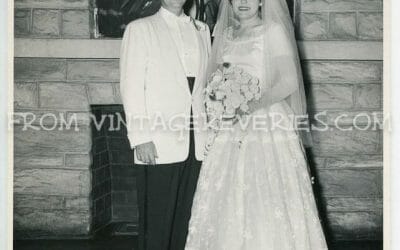
1930s Wedding Photos, and How to Date old photos by hair style

1930s Wedding Photos, and How to Date old photos by hair style

Take a step back in time with these stunning 1930s wedding photos. Captured by St. Louis photographer J.J. Belka, these portraits reveal timeless elegance during the Great Depression. Learn how hairstyles, like the iconic pin curls, can help date old photos. Discover the fascinating intersection of vintage fashion and history through wedding photography trends of this era.

read more
1950s Wedding Photos: A Glimpse into Post-War Romance and Bridal Fashion

1950s Wedding Photos: A Glimpse into Post-War Romance and Bridal Fashion

Step back in time with these genuine 1950s wedding photos of Mary and her family. Discover post-war bridal fashion trends, the influence of Christian Dior’s New Look on wedding dresses, and how wedding photography evolved during this romantic era. These authentic vintage photographs, spanning from 1913 to the 1950s, reveal three generations of changing wedding customs, fashion, and American culture.

read more
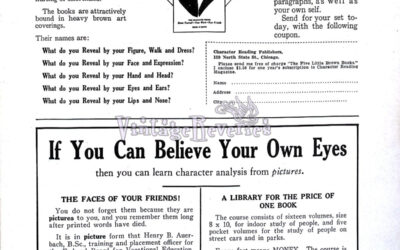
Snake Oil & Success: The Wild World of 1924 Advertisements

Snake Oil & Success: The Wild World of 1924 Advertisements

Step into the wild world of 1924 advertising, where Americans could purchase brain-hacking courses promising 1,000% salary increases, follow diets based on eye color, learn telepathic mind control, and train for glamorous hotel careers. These extraordinary advertisements from Character Reading magazine reveal how the Roaring Twenties birthed modern self-improvement culture—complete with Pelmanism, iridology, “Pep Cocktails,” and correspondence courses promising to transform desperate strivers into successful elites. Discover how snake oil salesmen, legitimate opportunities, and pseudoscientific schemes competed for consumers’ dollars and dreams in an era before advertising regulation, when anything seemed possible and everyone had a secret to sell.

read more
The 7 Rooms of Your Mind: A Guided Tour of Your Own Head

The 7 Rooms of Your Mind: A Guided Tour of Your Own Head

Step inside the mind as 1924 imagined it: a seven-room house where energy, intellect, artistry, and spirituality each occupy their own space. This captivating article from Character Reading magazine reveals how the Roaring Twenties understood personality through the now-debunked science of phrenology—offering a fascinating glimpse into vintage psychology, self-improvement culture, and the American obsession with scientific success.

read more
What Your Handwriting Reveals: A 1920s Graphology Workshop on T-Bars and Loops

What Your Handwriting Reveals: A 1920s Graphology Workshop on T-Bars and Loops

Step into a 1920s graphology workshop where your fountain pen strokes reveal hidden truths. Handwriting expert Hall Cameron’s 1924 analysis decoded personality through T-bars (the “barometer of courage”), the letter F (business mogul or missionary?), and disconnected script (surprise—you’re psychic!). Explore how Jazz Age Americans used handwriting analysis to understand themselves in an era of rapid social change, and discover what your own handwriting might reveal according to vintage personality science.

read more
The 1924 Sales Manual: Selling Cars by Face ShapeThe 1924 Sales Manual That Matched Cars to Face Shapes: A Bizarre Chapter in Automotive HistoryThe 1924 Sales Manual: Selling Cars by Face Shape

The 1924 Sales Manual: Selling Cars by Face ShapeThe 1924 Sales Manual That Matched Cars to Face Shapes: A Bizarre Chapter in Automotive HistoryThe 1924 Sales Manual: Selling Cars by Face Shape

In 1924, Durant Motors trained its salesmen to do something extraordinary: sell cars based on facial features. Round face? You needed comfort and padded seats. Pear-shaped face with a pointed chin? You craved beauty and luxury (but might not make your payments). This wasn’t one salesman’s quirk—it was official corporate policy, codified in a training manual by character reading expert Edna Purdy Walsh. Step into the strange world where jawlines determined which automobile you’d drive home, and discover how pseudoscience shaped the cutthroat competition of the Roaring Twenties auto industry.

read more
Do You Have the “Mental-Motive” Temperament of a High-Powered Attorney?

Do You Have the “Mental-Motive” Temperament of a High-Powered Attorney?

Before the LSAT and law school rankings, there was phrenology. This remarkable 1924 article from Character Reading Magazine reveals how career counselors determined legal aptitude by examining skull shape and facial bone structure. Real estate lawyers needed prominent “Locality” organs to avoid getting lost, criminal attorneys required heightened “Secretiveness,” and trial lawyers needed “Combativeness” bumps behind their ears. Explore this fascinating glimpse into Jazz Age vocational guidance, when your professional destiny was literally written on your face—and discover what the “Mental-Motive” temperament supposedly revealed about high-powered attorneys of the Roaring Twenties.

read more
Introducing the Founders Pass: My Digital Archive, Unlocked

Introducing the Founders Pass: My Digital Archive, Unlocked

I’m opening up my private scan vault. The new Founders Pass gives you 90 days of access to my growing digital archive: high-res PDFs and zipped image files from rare, useful public-domain publications—including the 1924 St. Louis Fashion Pageant, Character Reading magazines, and a 1916 book of birds. I’m building this as a living collection (not a one-off product drop), and I’m donating 5% of membership revenue to the Internet Archive to support preservation work.

read more
1920s Baby Readings: Determining a Career Before They Can Walk

1920s Baby Readings: Determining a Career Before They Can Walk

In 1924, anxious parents didn’t just worry about milestones—they sent baby photographs to Character Reading magazine to discover if their infant was destined to become a banker, surgeon, or concert pianist. Explore the fascinating world of 1920s baby character analysis, where phrenology met parental ambition and editors confidently predicted careers based on skull shapes and facial features. From “Baby Dan the banker in the bud” to dietary prescriptions for chemical deficiencies diagnosed from photos, these vintage readings reveal the hopes, anxieties, and pseudoscientific beliefs of Jazz Age parenting. A charming and slightly unsettling glimpse into how every generation tries to unlock their children’s futures.

read more
The “You and I” Faculty: Why Some Men Are Different When You Get Them Alone

The “You and I” Faculty: Why Some Men Are Different When You Get Them Alone

In December 1924, Character Reading Magazine explored a fascinating concept called “Conjugality”—the brain faculty that supposedly explained why certain men seemed dull at parties but transformed into attentive, passionate companions in private. Rooted in phrenology, this “You and I” faculty offered Jazz Age women a seemingly scientific way to understand selective love, marital compatibility, and the distinction between romantic passion and parental devotion. While the skull-reading science has been thoroughly debunked, the behavioral observations reveal timeless insights about introversion, attachment styles, and the search for lasting love. Explore this captivating glimpse into 1920s relationship psychology and self-improvement culture.

read more
Why Some People Love Storms and Mountains: The “Sublimity” Bump

Why Some People Love Storms and Mountains: The “Sublimity” Bump

Ever wondered why some people love thunderstorms while others prefer sunny days? In 1924, character readers believed it was all about “Sublimity”—a brain center that governed our love of majesty, grandeur, and the sublime. Explore this fascinating vintage personality theory featuring silent film star Alice Joyce, complete with practical lifestyle predictions and the pseudoscience that captivated Jazz Age America.

read more
Is Your “Personality House” Crumbling? A 1924 Structural Engineer’s Guide to Character

Is Your “Personality House” Crumbling? A 1924 Structural Engineer’s Guide to Character

What if your personality were a house—would it pass inspection? In December 1924, psychologist Honore Wright asked this revolutionary question in Character Reading Magazine, creating a metaphor that brilliantly merged America’s construction boom with emerging psychology. Walk through “Personality Town” and discover whether your foundation is crumbling, your lights are flickering, or your heating system needs repair. From calcium-rich diets for building “structural bones” to the wild world of 1920s advertisements promising everything from telepathic powers to “iriological diets” based on eye color, this deep dive reveals how the Roaring Twenties shaped modern self-improvement culture—and why these century-old insights remain surprisingly relevant today.

read more
Do You Have the “Author’s Forehead”? A Phrenology Check for Writers

Do You Have the “Author’s Forehead”? A Phrenology Check for Writers

In 1924, aspiring writers didn’t need talent or practice—just the right bumps on their forehead. This vintage guide from Character Reading magazine claimed phrenology could unlock your hidden literary genius by measuring your skull’s “seven rooms.” Featuring analyses of Charlie Chaplin and bestselling novelist Vicente Blasco Ibáñez, this peculiar slice of Jazz Age pseudoscience reveals how desperately people sought shortcuts to creative success. Could your forehead bumps predict bestseller status? Discover what the phrenologists believed in this fascinating dive into 1920s self-improvement culture.

read more
Don’t Fear Wrinkles! A 1924 Guide to Reading Your Face Lines

Don’t Fear Wrinkles! A 1924 Guide to Reading Your Face Lines

In December 1924, Character Reading magazine published a revolutionary article that challenged the beauty industry’s anti-wrinkle hysteria. Writer Edna Purdy Walsh argued that facial lines weren’t signs of aging—they were biographical maps revealing your thoughts, character, and life experiences. Discover how this Jazz Age perspective on “good wrinkles” versus “bad wrinkles” offered women permission to age with dignity, what different facial lines meant according to 1920s physiognomy, and why this nearly century-old message about embracing your face’s story resonates more powerfully than ever in our filter-obsessed modern world.

read more
Mother or Actress? The 1924 Struggle for Identity

Mother or Actress? The 1924 Struggle for Identity

In 1924, American women faced an unprecedented identity crisis. Just four years after winning the right to vote, they were caught between the glamorous “New Woman” ideal and traditional domesticity. A remarkable article from Character Reading magazine offered surprising wisdom: courage isn’t about being fearless everywhere—it’s about finding the role where you truly belong. Explore this timeless message about authenticity, confidence, and the struggle to be yourself in a world demanding you be everything to everyone.

read more
Square Jaws vs. Smiling Faces: The 1924 Sales Manual

Square Jaws vs. Smiling Faces: The 1924 Sales Manual

Before “closing techniques” and “sales funnels,” there was geometry. In 1924, aspiring salesmen were advised to check their facial lines, measure their skulls, and project the right “feeling tones.” This article from Character Reading magazine reveals how phrenology, racial pseudoscience, and surprisingly modern psychology collided in Jazz Age business culture—when your head shape could make or break your career.

read more
The Science of Soulmates: 1920s Advice on the Chemistry of Love

The Science of Soulmates: 1920s Advice on the Chemistry of Love

Discover how Americans in 1924 used chemistry—literal test tubes and scientific theories—to find their soulmates. This fascinating dive into Jazz Age dating culture reveals how the revolution in courtship, from parlor visits to automobile romance, sparked a scientific approach to love that mirrors today’s algorithm-driven dating apps. Featuring the “Triangle of Love,” oil-and-water compatibility tests, and warnings about petting parties, this expanded look at vintage relationship advice proves that humans have always sought formulas for lasting love.

read more
Welcome to 1925: The Year of the Graphologist and the Auto Expert

Welcome to 1925: The Year of the Graphologist and the Auto Expert

Step back into the winter of 1924-25 with a rare copy of Character Reading magazine—a fascinating time capsule of American self-improvement culture during the Jazz Age. This digitized issue reveals how Americans navigated an era of unprecedented change through graphology, personality analysis, and vocational training in the “new tech” industries of electricity and automobiles.

Edited by the remarkable husband-and-wife team of W. Thomas Walsh and Edna Purdy Walsh, this magazine offers a window into an era when handwriting analysis was considered a marketable social skill, when electricians and auto mechanics could earn life-changing wages, and when women were carving out influential roles in publishing and psychology. Discover the origins of American self-help culture and the promises of prosperity that captivated readers 100 years ago.

read more
The Relaunch, The Release, and The Redemption: My 2025 Sales Recap

The Relaunch, The Release, and The Redemption: My 2025 Sales Recap

If 2025 had a theme, it was “relaunch.” After years of humming in the background, I woke Vintage Reveries up—and it was the most fun I’ve had in a decade. From the rare 1990 WCW Starrcade crew shirt that sold in hours to the symbolic “liberation” of over 50 vintage fur coats (including a few “party furs”), this year wasn’t just about sales figures. It was about stewardship, history, and finding the right next chapter for items that have traveled with me for years. Here is my recap of the best, rarest, and most meaningful sales of 2025.

read more
A new car in 1944

A new car in 1944

A new car in 1944 was much more than a shiny machine in the driveway—it was a symbol of hope, stability, and life moving forward in the middle of World War II. These WWII-era Kodachrome slides capture a young couple standing proudly beside their car: he’s in uniform, she’s radiant, and together they embody the quiet resilience of the American home front. In rich, saturated color, the photos reveal not just their smiles, but the broader story of rationing, scarce automobiles, and the early days of color slide photography. This post looks closer at those moments, placing this “new” car and this couple’s joy into the larger history of 1944, wartime life, and vintage photography.

read more
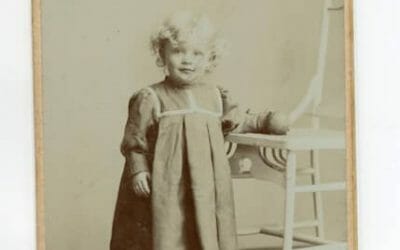
A turn of the century Swedish Girl, German turn of the century photos, & random

A turn of the century Swedish Girl, German turn of the century photos, & random

This post explores a small but rich collection of vintage images: baby cabinet cards from German studios like Emil Tiedemann and Thiele, a New York portrait by J. Gurney & Son, and a Milwaukee photo by Hugo Broichl—plus later snapshots from the 1950s. Together they trace how families in Sweden, Germany, and the United States used studio portraits and early cameras to capture fleeting moments of childhood and identity at a time when every photograph was planned, precious, and meant to last.

read more
Letting It Go, Listing It Right: Def Jam, Mouse Pee, and the Fur Coat Era I’m Releasing

Letting It Go, Listing It Right: Def Jam, Mouse Pee, and the Fur Coat Era I’m Releasing

I finally found the receipt for the Eric B. & Rakim t-shirt I sold in 2012. I sold it for $255.58. It was worth $1,700. As I unpack my inventory in West Lafayette, I’m confronting the “stagehand” collection and the “fur coat era”—inventory I held onto as armor against poverty and reminders of a past life. This is the story of letting go, pricing correctly, and stepping into 2026 light.

read more
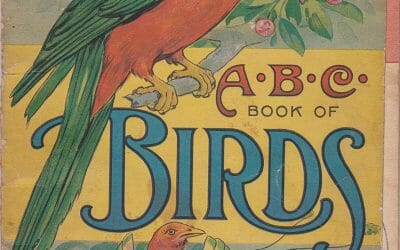
The A B C Book of Birds

The A B C Book of Birds

Step back to 1916 with The A B C Book of Birds, a beautifully illustrated children’s alphabet book that blends early-20th-century natural history, education, and art. Featuring 27 birds—from familiar robins and owls to exotic macaws, lyrebirds, and even the extinct dodo—this little volume pairs Carolyn S. Hodgman’s sing-song verse with vibrant chromolithograph illustrations by Will F. Stecher of Stecher Litho Co. of Rochester, New York.

I’ve carefully scanned the original, well-loved copy so you can explore every page in high-resolution detail, from the texture of the paper to the rich color layers of the lithography. The complete unwatermarked book is available as a digital download, and each bird has also been separated out into its own artwork—perfect as vintage-style prints for nurseries, playrooms, classrooms, or anyone who loves birds and antique illustration.

read more
Where I Got (Most Of) My Vintage: The DonnaLand Year

Where I Got (Most Of) My Vintage: The DonnaLand Year

I didn’t plan to become a vintage seller. In 2011 I rode a freight elevator to the top of a Lemp Brewery warehouse and fell into 22 tons of clothing at DonnaLand. Dust, drama, union tags, and lessons. This is how I learned the trade the hard way, burned out, and came back in 2025 with systems, AI, and a shop I can sustain.

read more
1935 Shoe fashions for women, men, and children

1935 Shoe fashions for women, men, and children

Explore the fascinating world of 1935 shoe fashions through scans from the Chicago Mail Order Company catalog! From practical kid leather women’s shoes and “super comfy” nurse oxfords to durable work boots for men and cheerful styles for girls, this catalog captures the balance of practicality and style during the Great Depression. Discover the timeless charm of vintage footwear designed to meet the needs of hardworking families while still delivering thrilling and optimistic styles. A true glimpse into 1930s fashion history!

read more
How Vintage Saved Me (Again): Relaunching My Shop After Burnout

How Vintage Saved Me (Again): Relaunching My Shop After Burnout

After a few wild years of job changes, burnout, and moving states, I’m finally back in my happy place: a bright studio full of mannequins, ring lights, and boxes of forgotten vintage. In this post, I share how Vintage Reveries is relaunching from my new workspace and why vintage still feels like the thread that pulled me through.

read more
A woman in a WAC uniform reading a newspaper during WWII.

Get 10% Off Your First Vintage Find

Subscribe to receive a 10% off welcome coupon by email, plus early access to new vintage drops, behind-the-scenes sourcing notes, and scans of the old photos, programs, and paper ephemera I uncover and digitize.

Almost there! Please check your email inbox right now and click the link in our confirmation message to complete your subscription. (If you don't see it, check your spam folder!)

Pin It on Pinterest

Share This

Like this? Share This!

Share this post with your friends!

×